10-12 September 2022: For as long as I can remember I have been a keen cyclist, stretching back to my early teens when I first owned a racing bike and joined a cycling club.
Although I fully interrupted being a biker in my 20s and 30s in favour of running, my first and most enduring sporting love has been ‘the bike’.
I say as much in a chapter in my self-published memoir, Keep on the Move, where I describe the sport’s attractions and how I first got into it, listing as well the specific ways I have found it enjoyable (read it HERE).
A later page on this website fills out further details, including showing a few photos of me ‘in action’ on the bike at different times in my life.
I am of course not the first person to write enthusiastically about biking as a sport and recreation.
Bookstores confirm as much. Many of their shelves are well stocked with texts dedicated to different aspects: histories, biographies of famous racers, training guides, route surveys, DIY bike maintenance manuals, and much more.
There are even ‘philosophical’ studies about biking, like Fritz Allhoff’s Cycling Philosophy for Everyone, which has chapters in it titled ‘Bicycling and the Simple Life’ and ‘Taking the Gita for an Awesome Spin’.
And there are one or two famous novels that have cycling at their heart, such as Flann O’Brien’s gloriously weird The Third Policeman, from which I like to quote “how can I convey the completeness of my union with the bike, the sweet responses she gave me at every particle of her frame”.
And then there are the numerous magazines, of which Cycling Weekly is still my most favoured read. Parts of it are quite daft; but the overall impact is reassuring and very pleasing on the eye, especially its reviews of new bikes and the latest kit, including gadgets.
Paul Maunder’s recently published lyrical meditation on what it means to ride a bike – The Wind at My Back – corresponds exactly to my experience, especially when he writes:
Cycling is a sport for romantics. Its legends are created through suffering, and whenever you ride a bike you can understand that suffering. . . . . Over the years we build our own personal cycling mythology, a kind of memory bank containing the images that are important to us – epic rides, races won or lost, roads that have punished us. . . . They come with me on every ride.
If some of that sounds a bit grim, consider too, by contrast, that riding a bike is an effective salve for depression, in part because it releases into the body chemicals known to lift our mood – serotonin, dopamine and endorphins. I have also read a medical journal article that says memory, reasoning and planning are all boosted after just thirty minutes on the bike.
That’s never been my experience. Nor have I wished it to be. Indeed it’s the sheer mindlessness of biking that often causes me to want to do it, entirely because cycling allows me briefly to forget my troubles and busy life as I enjoyably seek the distracting sensation of feeling my body in rhythmical movement, which I allow to take me over.
There’s also of course the aesthetic pleasures that riding lovely routes give. The world really does look differently and better when you’re sat on top of a bike, I find.
I agree 100% with Paul about those important images – memories of rides that positively mattered at the time of completing them, which make one feel psychologically good as they are recalled repeatedly to mind, particularly if they entailed a significant challenge that had to be overcome with beyond the normal effort.
The chapter in Keep on the Move I mentioned earlier is full of such images, particularly epic rides I have ridden over the years, like the famous ‘End to End’ (E2E, Land’s End to John O’Groats), which I rode in just over two weeks eleven years ago, in 2011.
And now I have a new deposit to make in my memory bank of good epic bike rides – the so-called ‘Sea to Sea’ (C2C on the sign posts), which I completed with my son, Jake, and his wife, Amanda, in three days, beginning the day before my 75th birthday on Saturday 10th September.
Choosing to complete this iconic ride in just three stages (4 is preferred by the majority) meant that we each felt very tired at the end of each day of it.
One guide book says that 3 days is a “good choice only for sporty, fit cyclists”. It is right, which is why we each put in the miles beforehand to prepare, especially me, riding at least 140 each week for nearly two months, simulating twice biking over 50 in a single session. I also dieted to lose weight. The ride is advertised as a ‘holiday adventure’ in the biking brochures, suggesting it’s a ‘leisure’ experience. It isn’t.
The 143-mile linear ride took us from Whitehaven on England’s west coast, through the northern Lake District, into the north Pennines, and then onwards through Weardale to the River Tyne and on to Tynemouth.
We were in the saddle for nearly 20 hours, thus averaging 7 mph over the whole route. That doesn’t sound very fast; and it isn’t, bearing in mind I normally complete a 20-mile ride in double that speed. But, then, when I ride the country lanes close to my home I am not climbing uphill so much and for so long.
Over the three days of our C2C ride we climbed nearly 12,230 feet. That’s a big number, which included, in addition to many short bitter climbs, two monster leg-shattering ones, each 4 miles long – Whinlatter Pass, 7 miles west of Keswick in the Lake District, which averages 7%; and Hartside Pass, 12 miles west of Penrith in the Pennines, which averages 6%. They both took some getting up, I don’t mind admitting, particularly Hartside, which is regularly used for pro and amateur bike races. It seemed to go on for ever, reminding me of the Le Tour cols I used to ride up and over in my 50s. I found the last half mile especially hard. On the other hand, I have always been impressed how quickly one recovers from such effort, for within 5 minutes of cresting Hartside Mount, where I rested and took in the super views, I was in sufficient good order to carry on. Biking is like that when you’re fit for it.
Climbing up so many feet in just three days made the C2C more of a challenge than the E2E. The total elevation of that last ride is about 14,000 feet, making it counter-intuitively a less demanding prospect than the much shorter C2C, entirely because its climbs are spread over nearly two weeks rather than a few days. By riding West to East, which is the recommended option, we also experienced steeper climbs than if we’d gone East to West.
The reverse side of climbing of course is descending. In biking, the standard rule is: for every up, there is a down.
Some of the downs we rode were exhilarating, particularly the descent after Allenheads in Northumberland: nearly 6 miles of uninterrupted downhill to Rookhope, on a near-perfect surface, averaging -5%, which is where I achieved my top speed for the ride – 37 mph, Jake peaking at 39.
The worst downhill section was the very steep descent to the bleak Pennine settlement of Nenthead. OK, it was only just over a mile long. But safely navigating a bike down a -20% incline, maxing at -25%, took some doing. The rims on my front wheel were scorching hot at the bottom. No wonder this descent is labelled a ‘Bicycle Accident Spot’. My heart was in my mouth as I jarringly made my way down. Jake and Amanda sensibly got off and pushed.
We experienced some spectacular and contrasting scenery – fell tops, forests, green river valleys, bleak exposed moorland – and rode through some lovely villages and market towns – Kirkland, High Lorton, Threkland, Mungrisdale, Troutbeck, Stanhope – following a cleverly conceived route devised by Sustrans, which mostly avoids main roads in favour of minor byways, country lanes and dedicated cycling tracks. We rode straight through Keswick, however, with barely a backward glance, finding it overcrowded with tourists whose preoccupations seemed to be less about enjoying the great outdoors as shopping and eating out.
And the weather held good, with only a small amount of fog out of Allenheads and a brief shower near Consett. Apart from that, we experienced three fine days.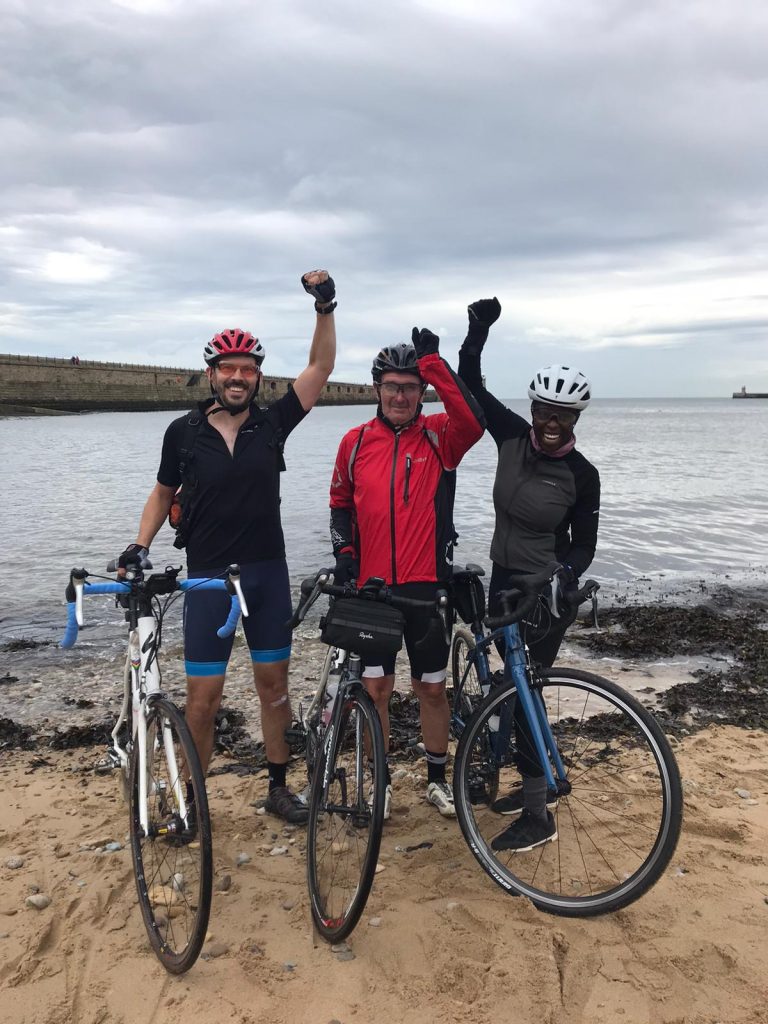
I was pleased to complete this ride for two reasons apart from the actual biking itself.
The first was the opportunity it gave me to spend a lot of quality time with Jake and Amanda, who were perfect companions, both on and off the bike.
Amanda was the less experienced biker in the party, which meant she had to work extra hard on occasion to complete each day’s ride. She faltered not for a single moment, never complaining when the going got hard. She was totally up for it, in other words. And I suspect, because of this, she got more out of the ride than Jake and me combined.
The second was being able to celebrate my 75th birthday – a milestone in itself – with both of them at the end of Day 2 in the Allenheads Inn.
As I blew out the candles on the cake they had laid on to mark the occasion, I said a silent prayer: “Thank you. Who’d have thought two years ago, when you had a life-threatening heart attack, that you’d be here now, doing this? You’re a most fortunate man.”
PS
There are two published guides to the C2C. I do not recommend the one written by Richard Pearce, The Ultimate C2C Guide (2020). It looks very good on paper with its coloured maps and spiral binding; but its descriptions of the big climbs are thin, even unhelpful; and its survey of the final 20 miles is not easy to follow. Jeremy Evans’s The C2C Cycle Route (2021) is much better, I think. It charts the route using edited extracts from relevant OS maps, which makes cross-referencing easy; its advice is always practical and sensible; and its descriptions of the way forward are uncomplicated. A very good waterproof map of the route based on OS data is produced by Footprint – www.footprintmaps.co.uk