Thursday 27 January 2022: Next Wednesday is an important anniversary for all those, like me, that have a very high regard for James Joyce’s epic, encyclopaedical, satirical, and hard to read work, Ulysses, which Anthony Burgess once evaluated as the greatest novel of the 20th century.

For 2nd February 2022 is the 100th birthday of its publication as a complete book, in Paris, coinciding with the author’s fortieth birthday.

Its first appearance also roughly tallies with the emergence of Ireland as an independent free state, which formally came into being a few weeks earlier.
Thus, it appears, the first great modernist novel was published at near the same time as the advent of the first modern European state.
The redemptive glimpses that Ulysses offers of a better of way of living is maybe Joyce’s way of anticipating a utopian future for his homeland.

Of course, while this is most likely accidental, it may not be incidental, not least because Ulysses is written by an Irishman – albeit a self-exiled one – who cleverly, and in exacting detail, over many pages of verbal inventiveness, recreates some of the streetscapes, institutions and unusual characters of Ireland’s colonial capital, Dublin, on a single day at the turn of the 19th century – 16th June 1904.
Accompanied by Leopold Bloom and Stephen Dedalus, Joyce takes us on a walking ambit of the city centre, which is helpfully recreated in the form of 8 ‘tours’ in Robert Nicholson’s The Ulysses Guide.
Some of the photographs accompanying this post show me following the various routes he recommends. I wonder if you can work out where I am, and which episodes they apply to. 
BBC Radio 3, I notice, is acknowledging the occasion of the first appearance of Ulysses with a series of five short broadcasts in its Essay slot, beginning on Monday 31 January, while Radio 4 is dedicating Archive on 4 this Saturday to the novel. Nothing on TV, as far as I can tell.
I haven’t decided how I will recognize the anniversary, other than to listen to those programmes, though it’s likely I will do what I always do on ‘Bloomsday’, which is to read an episode from the novel, choosing one that reflects especially well on its central character, Leopold Bloom, Joyce’s masterwork of characterization, who I was so pleased to meet when I first properly read Ulysses, aged 41, in 1988.
The nature of that experience, plus a subsequent one like it, is written about HERE
Both were a huge test of patience and concentration, entailing fathoming out a host of unusual historical and literary allusions, plus getting to grips with scores of puns, jokes and foreign phrases. Thank goodness for Don Gifford’s Ulysses Annotated, is all I can say.
In that earlier appreciation, I quote Joyce’s greatest biographer Richard Ellman’s generous estimate of Bloom: a humble vessel elected to bear and transmit unimpeached the best qualities of the mind.
More recently, the comedian and writer, David Baddiel, in a conversation with Irish Times arts and culture editor Hugh Linehan about his new book, Jews Don’t Count, says much the same, but more, reminding us that Bloom is Jewish. In the novel, he is subjected to regular anti-Semitic prejudice, which he subtly and repeatedly challenges, particularly in the extra-long Cyclops episode: It’s incredible how right Leopold Bloom is [says Baddiel]. In my experience, non-Jews writing about Jews, they just don’t get it right most of the time. To some extent, they just foreground the Jewishness too much. The one time that doesn’t happen is [with Joyce’s] Leopold Bloom. And I literally can’t fault him, in the way he is, the way he thinks. He’s Everyman, yet there is something really Jewish about him, there’s an evanescent quality about him that Joyce absolutely gets.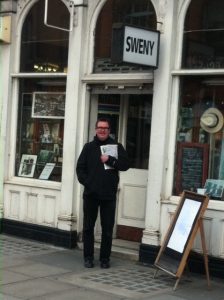
When, in The Cyclops (Episode 12), Bloom is confronted by the ‘one-eyed’ citizen, a virulent anti-Semitic Irish nationalist, he patiently makes the case for an open, tolerant Irish nationalism – A nation? asks Bloom. A nation is the same people living in the same place (p.430).
And, when rebuffed and threatened subsequently, Bloom reasonably fights back, saying, Mendelssohn was a Jew, and Karl Marx and Mercadante and Spinoza. And the Saviour was a Jew and his father was a Jew. Your God ….Your God was a Jew. Christ was a Jew like me (pp. 444-5).
I have written myself into reading The Cyclops episode next Wednesday, don’t you think?
And maybe also the short chapter about it in Daniel Mulhall’s newly published book Ulysses: A Reader’s Odyssey, in which he writes: Cyclops is crucial in identifying Bloom as an apostle of tolerance and moderation in a world trending towards extremes. To that extent, Bloom challenges the populist mood of our current times.
In his fine book, Ulysses and Us: The Art of Everyday Living, Declan Kiberd is also truly spot on when he writes: here [in this episode] Bloom knows and feels a lot more than anyone else . . . he is the more dignified protagonist . . . his role is not to teach any great truth in words, but simply to embody a better way of being in the world.
I have written as much myself, reflecting similarly on the experience of first meeting Bloom: I became totally absorbed. I began to think Bloom-like thoughts, wishing I was more like him – to love without being possessive; to be generous without being prompted; to be magnanimous without being sycophantic; to be sincere without being bigoted; to be strong without being assertive; to be simultaneously cosmopolitan and supremely local; and to be practically minded as well as intellectually driven.
It’s easy then to appreciate and admire Bloom, whose credo from Cyclops I like to quote:
But it’s no use, says he. Force, hatred, history, all that. That’s not life for men and women, insult and hatred. And everybody knows that it’s the very opposite of that that is really life.
What? says Alf.
Love, says Bloom. I mean the opposite of hatred (p.432).
Bloom’s credo here is spoken. But so much of what we know about him is based on his recorded thoughts – those internal monologues that are such a feature of the novel which caution us to reflect on the relationship between our inner and outer lives: where does one begin and the other end? Are they all of a piece? In Ulysses, it’s not clear. But, then, in practice, it often isn’t.
The Irish novelist, Anne Enright, correctly sums up the implications: More than any other book, Ulysses is about what happens in the readers’s head. The style obliges us to choose a meaning, it is designed to make us feel uncertain. This makes it a profoundly democratic work. Ulysses is a living, shifting, deeply humane text that is also very funny, It makes the world bigger.
It is also sometimes said that Ulysses is a novel in which a key theme is the coming into being of the book itself. This is effectively what Stephen Dedalus is tasked with: to write Ulysses. I want you to write something”, Myles Crawford, the editor of the Freeman’s newspaper says to him. “You can do it . . . Put us all into it, damn its soul (p.171).
In my case, Ulysses is more of a book which brought me into being as a new kind of reader, particularly of fiction. As Joyce’s most recent biographer, Gordon Bowker, says, Stephen’s philosophical meanderings, Bloom’s day-dreaming, and Molly’s nocturnal reveries, demand a new kind of reading, and a new kind of readership”
Bowker here is leaning on Ellman’s earlier observation that Joyce requires that we adapt ourselves in form as well as in content to his new point of view, which is to do with privileging the commonplace, using a rich mix of contrasting prose styles that mimic its interior and exterior dynamics.
And it introduced me to some very amusing quotes, of which this one is my all-time favourite:
I am exhausted, abandoned, no more young. I stand, so to speak, with an un-posted letter bearing the extra regulation fee before the too late box of the general post office of human life (p.642).
Only Joyce could have written that, don’t you agree?
Saturday 15 January 2022: Adam Phillips, my favourite Freudian, has an interesting essay in the current edition of LRB (6 January 2022).
Its theme is ‘opting out’, in which Phillips challenges his readers to consider whether there are any pleasures in giving up rather than carrying on: “The question I want to broach is not why do we give up, but why don’t we? What are we doing to ourselves and others, sometimes, by not giving up?”
Phillips, unsurprisingly, draws Freud’s ‘death instinct’ into his queries – “the part of the self that wants to give up, to give up on perpetually attempting and achieving a renewal of life” which he connects with “a continual debate going on inside us . . . . about whether we really believe that life is worth living, whether life is worth the trouble”.
He writes what I often think – that “it is shocking what people will put up with; it is astounding how few people kill themselves.”
The restorative effects of sleep are also worth considering, Phillips says: “every night we give up: give up consciousness, give up thinking, give up vigilance, give up alertness . . . give up on a waking life.” To that extent, sleep “is [maybe] the clue to an ample sense of the value sometimes of giving up”.
But that is not how we normally think of sleep, is it? Nor does the idea that life is worth living present itself to us as a belief. Rather, as Phillips correctly says, “we are more likely just to go on living as if it is true”.
When we start to doubt its truth, we are thus asking ourselves: what is worth surviving for? And even: what is worth not surviving for?
Me? In the last case, I would consider my life not worth living when it becomes pointless through gross physical and mental disability or ferociously distracting pain, making me an inevitable nuisance not just to myself but to others. That’s the kind of life I’d want to give up, as my living will explains.
What’s worth surviving for, providing I am compos mentis, on the other hand, needs thought.
Freud’s answer is ‘pleasure’; Marx’s ‘social justice’.
Together, do they touch all my bases? Broadly defined, I think they might, providing I am able still to enjoy the former and help to promote the latter.
Friday 14 January 2022: At the start of City of Books, a chapter I wrote in 2017 about the holding power of serious literature (read it HERE), I approvingly quote the English author Geoff Dyer: “certain books are held dear because they are psychic landmarks revealing where and how they helped us come into a better consciousness”. The critic Edward Said has written similarly: “I pick up a book . . . What I find inspires me, or moves me, animates me, gets me excited intellectually.”
This post identifies and comments on three books I first read many years ago that significantly helped me then to come into a better consciousness, and which move and animate me still in my old age.
These books, each of which is short in words, but profound in substance, are classics; and they are related. The first two envisage a better society; the third a more human way of living socially in a small community.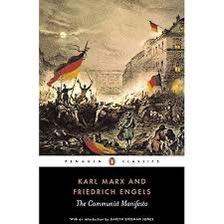
Marx and Engels’ The Communist Manifesto, first published in 1888, initially came into my life during the fortnight before I left grammar school in 1966, when, aged 18, I read it as one of several titles recommended as important by my then general studies teacher.
I recall reading my own newly purchased copy in a single afternoon, underlining numerous passages on its pages whose meanings I thought coincided with the socialist ideals I was beginning at that time to ferment in my imagination.
I still have that copy. And I still approve of the highlights I made in it fifty-six years ago.
At one point in the Manifesto, Marx and Engels identify a set of “necessary measures” designed to usurp the “old social order”.
These include: the “abolition of property in land and application of all rents of land to public purposes”; the introduction of “a heavy progressive or graduated income tax”; the “centralization of credit in the hands of the state by means of a national bank with state capital and an exclusive monopoly”; the “bringing into cultivation of wastelands, and the improvement of the soil generally in accordance with a common plan”; the “gradual abolition of the distinction between town and country by a more equable distribution of the population”; and the provision of “free education for all children in public schools”.
I subscribed then to each of these measures; I still do. I also persist in thinking Marx’s analysis of the alienating and inequitable effects of unchecked capitalist growth is fundamentally true, which is why other passages in the Manifesto continue to inspire and tutor my political judgement:
“The ruling ideas of each age have ever been the ideas of its ruling class”; “we shall have an association in which the free development of each is the condition for the free development of all”; “Communism deprives no man of the power to appropriate the products of society; all that it does is to deprive him of the power to subjugate the labour of others by means of such appropriation”; “The distinguishing feature of communism is not the abolition of property generally, but the abolition in particular of private bourgeois property . . . which capitalists use to exploit wage labour”; “The written history of all hitherto existing society is the history of class struggle”.
I was a Christian socialist before encountering the Manifesto. After reading it, I became a Marxist socialist. I continue to be.
Next up is Thomas More’s Utopia, the first edition of which came out in 1516. The version I own is dated 1965. I first read it in 1986, aged 38.
While there is no evidence to indicate that either Marx or Engels knew of, least of all read, More’s blueprint of the perfect republic, we do know each was impressed by similar visions, though cautious about interpreting them as providing enough impetus for bringing about the sort of social transformation they regarded as a human necessity. Only revolutionary struggle, they both insisted, could achieve that. Good ideas were a necessary condition for radical change; but they could never be sufficient for it.
My initial encounter with More’s little book was provoked by taking part in a bruising debate about the future of comprehensive education held in Oxford in the summer of 1986, to which I made a significant contribution, advocating strongly progressive views which many in the room – mostly headteachers – found objectionable, provoking one of them to say, “you’re nothing but a utopian, a builder of castles in the sky”.
This was meant as an accusing insult, and I took it as such, consequently angrily over-reacting, neglecting to say that my utopianism had a distinguished literary and philosophical pedigree, which More instigated, and from which we can learn a thing or two. I didn’t because I was ignorant of it.
But I did read Utopia soon after to learn what I should have said, and I also drew on it and other relevant literatures subsequently to write Hope and Education, a book about the relevance of the utopian imagination for discussions of educational policy, which was published 17 years later in 2003.
More’s Utopia I learnt in 1986 does not consistently advocate progressive ideals. More is comfortable with slavery, for example.
His utopian ‘method’, on the other hand, which holds up a mocking fantastical mirror exposing the distortions of real-life societies, is cleverly insightful. Reading about it for the first time reminded me of the important role visions should play in practical politics.
It confirmed in my mind the view that ‘being politically realistic’ is an empty slogan in the absence of them. What works is not always what’s best. What’s best should be based on ideals and not just on what is considered feasible.
More’s vision then caused me to be more confident in expressing myself about the form and character of a better society – a socialist society – drawing me into an imaginary perfected world that helped me to think critically about the one I ordinarily exist in and help to recreate.
It inspired and animated my political consciousness, in other words, which means that, to this day, conducting utopian thought experiments continue to be part of my make-up as a political activist. More’s Utopia kick-started this habit.
Meanwhile, Saint Benedict’s Rule, composed in Latin in about 540, which I first came across in my early 30s at a religious retreat in Dorset, and about which I have written elsewhere on this website (see below at ‘Worth Abbey’ and my Church Page), gave me my first significant insights into what might make a balanced and fulfilled personal existence, showing me in particular how the ordinary and the humdrum could become the opportunity to find the presence of God in my own daily life.
I am not saying for a second that I have ever fully responded to the Rule’s call. On the contrary, all manner of factors has sadly got in the way of me achieving that; and its requirements – especially as set down in Chapter 7, which is about the importance of humility and how to achieve it – are deeply challenging, particularly for someone like myself who has often been suspicious of its status as a virtue.
Even so, the journey prescribed by Benedict offered me a directional map which I still take very seriously, though I regularly wish I had attended to his guidance more closely in my middle years, which I am convinced would have been lived better than they were if I had.