Sunday 12 June 2022: Today is Trinity Sunday, one of the most important Feast Days in the Anglican and Catholic liturgical year.
This feast day, as its name indicates, celebrates the Christian doctrine of the Trinity, the three Persons of God: the Father, the Son, and the Holy Spirit.
The New Testament contains no explicit trinitarian doctrine, which means that many Believers struggle to make sense of it.
It was first formulated among the early Fathers of the Church as they attempted to understand the relationship between Jesus and God in their scriptural documents and prior traditions.
For Unbelievers, it’s a doctrine that seems incomprehensible; for Believers like me it is a Mystery – an example of what I have elsewhere described as an attempt to “word the unwordable” (see HERE). It simply isn’t possible to find words adequate sensibly to communicate the idea that God is One, but is experienced as three ‘persons’.
I guess this is why many priests resist giving sermons on the doctrine on Trinity Sunday; and, if they do, often get themselves into all sorts of knots trying.
Mind you, I still recall happily from my youth one such brave effort, resulting in the priest saying something like this: The Trinity is like three musicians playing a trio sonata. Although they play on different instruments, the musical piece created is a wholeness.
More recently, I have found helpful the words of my favourite theologian, Rowan Williams, on the topic, though you surely must first be members of the Faithful to begin to grasp their relevance. Unbelievers, I suspect, must find them unfathomable:
We call him the Son of God. But we do not mean by this that God has physically begotten him, or that he is made to be another God alongside the one God. We say rather that the one God is first the source of everything, the life from which everything flows out. Then we say that the one God is also in that flowing out. The life that comes from him is not something different from him. It reflects all that he is. It shows his glory and beauty and communicates them. …… And we say that the one God, who is both source and outward-flowing life, who is both ‘Father’ and ‘Son’, is also active as the power that draws everything back to God, leading and guiding human beings towards the wisdom and goodness of God. This is the power we call ‘Holy Spirit’. So, when we speak of ‘the Father, the Son and the Holy Spirit’, we do not at all mean to say that there are three gods – as if there were three divine people in heaven, like three human people in a room. Certainly, we believe that the three ways in which God eternally exists and acts are distinct – but not in the way that things in the world or even persons in the world are distinct.
Well, there you have it; or you don’t.
Interesting for me is some associated reading I have been doing lately which has relevance to the church’s trinitarian doctrine – Dante Alighieri’s Commedia. The number three, I have discovered, is so much an informing principle of his poem, with trinitarian allusions cropping up everywhere in it, despite Dante’s protestation that the Trinity is ultimately beyond human comprehension. Believers, he says, are therefore required to take it on trust: Mad is he who hopes that our reason can go down the infinite path taken by one substance in three persons. Be content, human kind, with what is (Purgatorio, 3, 34-7).
Elsewhere, Dante spells out his understanding of the doctrine: and I believe in three eternal persons, and I believe them to be one essence, an essence so one and so threefold that it takes ‘are’ and ‘is’ simultaneously (Paradiso, 24, 139-41).
I am rather impressed by Dante’s cleverness here. Saying that in the Trinity the verb to be is used in the plural and the singular at the same time is a smart move, successfully marrying the intellectual and mystical aspects of faith. It also coincides with what is found in the New Testament, as Dante testifies: With this deep mystery divine I’m broaching now, the gospels stamp my mind at many points (Paradiso, 24, 142-44).
I guess it must have also rung true to Dante as he uttered these words in his imagination at the very point at which he ascended into Paradise.
Friday 18 March 2022: Two weeks ago, I met a forgotten friend, Barbara Hepworth, in Wakefield, at an art gallery named after her.
The occasion was seeing a show of her work – Barbara Hepworth: Art & Life – which the gallery’s artistic director and Hepworth specialist, Eleanor Clayton, had curated.
All the gallery’s exhibition spaces were given over to an extensive display of Hepworth’s sculptures: early figurative marble and wood carvings and later textured bronzes and steel constructions, both small and large. On show as well were some of the artist’s geometric sketches and a selection of her less well-known hospital drawings of the late 40s.
While these exhibits only scratched the surface of Hepworth’s huge output, it was more than enough to remind me of why I was so taken up with her work when I first encountered it in my early 20s, coinciding with my first excited acquaintance with the stone abstract carvings of her contemporary, Henry Moore. But why hadn’t I bothered with it much since?
For sure, a few years ago, during a cycling holiday in Cornwall, I briefly visited Hepworth’s last home, now the Trewyn Museum Studio near St Ives, where I walked around its garden-strewn display of standing works; and previously I’d been to the Yorkshire Sculpture Park to see her multi-part bronze The Family of Man, completed shortly before her death in 1975. But, other than that, I only rarely consulted Hepworth’s work in my mental catalogue of visual art images.
Moore suffered from similar inattention, making me wonder why I’d mindlessly turned away from his and Hepworth’s abstract sculpture in my middle and later years.
Given my religious and utopian sensibilities, it ought not to have, because Hepworth’s vision in particular overlaps significantly with them.
Her creative philosophy, akin to aspects of my own much minor one, was unfailingly about seeking new ways better to express the experience of the spiritual within the physical, which meant that each sculpture she produced motivated in her the desire immediately to create an improved representation of the same image in her next effort: “There is always some falling short of the image, some imperfection; but one is carried forward to the next creative act by the force of the idea one is trying to express.”
Whatever, I was bowled over by Eleanor Clayton’s show, getting prepared to see it by buying and reading in advance her newly published and well-reviewed biography of Hepworth (CLICK HERE for details). I also caught up with Alan Yentob’s equally impressive Imagine profile of the artist first broadcast by the BBC two years ago.
A huge shock of positive recognition gripped me as I walked round Clayton’s show.
Each of the sculptural forms that impressed me on my first encounter with Hepworth in the late 60s, and that always had a special meaning for her, were on display: “the standing form (which is the translation of my feeling towards the human being standing in landscape); the two or three forms (which is the tender relationship of one living being beside and with another); and the closed form, such as the oval, spherical or pierced form, sometimes incorporating colour (which translates for me the association of meaning of gesture, either in nature or in the human spirit.)”
A fine example in Clayton’s show of the last of these forms was Configuration (Phira), which Hepworth carved in 1955. This hardwood sculpture reminded me of how much Hepworth enjoyed the process of creating a symbiosis between material and finished form: “the intense pleasure for me is in relating oneself to the ‘life’ in the particular material.”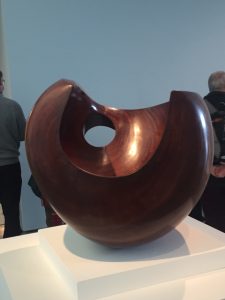
Its hemi-spherical shape faithfully follows the grain of the wood; while a hole carved into it invites one to look through the object and beyond it, constituting a material metaphor.
It’s also a poignantly optimistic piece. For the occasion of its carving was the premature death of Hepworth’s eldest son, Paul, news of which inaugurated an extended period of depressive grief for the artist.
Phira therapeutically recalls a cradle and a beating heart, while its polished hardwood gives off a warm memorial glow.
I am pleased to know I can continue easily to view Phira because Clayton borrowed it for her show from the City of Leeds Art Gallery where normally it is on permanent display.
Meanwhile, Hepworth’s earlier Three Forms (1939) reflects the relationships between the three babies she had given birth to in 1934, including her maternal loving bond to each of them.
Clayton’s description can’t be improved upon: “Three white marble rounded forms of varying sizes and character are place asymmetrically on a rectangular base of the same material. The base functions as the mother of the group, providing support, unbreakably connected by common physicality.”
Among the many examples of Hepworth’s standing forms on show in Wakefield, one particularly caught my eye – Two Forms with White (1963).
Like Phira, this is a hardwood carving; but, unlike the latter, it stresses the power of the vertical rather than the spherical in the landscape.
Clayton: “The two forms stand upright, Hepworth using the grain of the wood to emphasise their verticality, while incorporating the concavities of the landscape in their scooped, white-painted fronts.”
Holes link both works. In each piece we are encouraged imaginatively to look through and create something new on the other side, or simply to lean in and hope for the best – a piercing aperture, in other words.
As Hepworth said: “so much depends in sculpture on what one wants to see through a hole!”
Elsewhere, she writes: “I am most often aware of those human values which dominate the living structure and meaning of abstract forms. Sculpture is the fusion of these two attitudes. The dominant feeling is always the love of humanity and nature.”
Tuesday 1 March 2022: Earlier today, NATO’s chief, Jens Stoltenberg, called on Russia to end the war in Ukraine and withdraw all its forces, adding that the alliance would not send troops or combat jets to support Kyiv as it does not want to become part of the conflict.
The chances of the former happening sadly are non-existent; the news that the latter won’t be, on the other hand, is reassuring.
For while I am aghast at what Russia’s military is doing in Ukraine, the last thing I want is for the conflict to involve other countries. That could trigger a third world war, implicating nations that possess huge arsenals of nuclear weapons, one of which, Russia, has frighteningly already indicated a readiness offensively to use them.
Such considerations weren’t too evident in the comments made during a pair of interviews conducted last night by Mark Urban, the BBC’s Diplomatic Editor, while anchoring a Ukraine War special edition of Newsnight.
A much-published student of military history, Urban seemed taken-aback by the comments made about the progress of the war by his two studio guests – Inna Draganchuck, a Ukrainian Deputy Minister, and Britain’s General Sir Richard Barrons, former Commander of Joint Forces Command, as each talked up the possibility of NATO involvement in the event of heavy Russian artillery bombardment of Ukraine’s major cities.
Sir Richard spoke about “the application of NATO’s military power”; while Draganchuck willed the introduction of a NATO-enforced ‘no fly zone’ over her country.
“But that would mean war with Russia?”, a surprised Urban replied. Neither of his studio guests appeared to notice this rhetorical query. Nor did former Foreign Secretary, Jeremy Hunt, interviewed separately later. “Putin is a man that only understands strength”, he sombrely declaimed.
I don’t mind admitting I found it hard to go to sleep after hearing all of that.
Jens Stoltenberg’s assessment surely must prevail, I thought on first waking up this morning; and maybe too, I imagined, Ukraine’s president, Volodymyr Zelenskiy, needs to be encouraged to identify a way of speech-making that encourages finding ways to stop the war and not just effectively to prosecute it.
This is a war his country cannot win, which means he surely should be trying to find an off-ramp from the conflict to lessen the loss of life, on both sides.
I am told by some that this last sentiment is a betrayal of Ukraine’s just cause – that I am an appeaser of sorts. Really?
In the absence of direct military aid, it is surely madness to think Ukraine can successful beat back and put to flight a Russian military force that is massively superior to its own, both numerically and technologically.
Undoubtedly, its smaller army and airforce can frustrate Russia’s advance and delay Putin’s cynical victory.
But the loss of civilian lives this will inevitably entail cannot be glossed over. ‘Ought implies can’, don’t my armchair militarist critics know?
And as for me being an appeaser. Give me a break. The British Establishment, for over two decades, while trumpeting and seeking to export ‘western values’, has willingly cosied up to the Russian kleptocrats and, crucially, their money.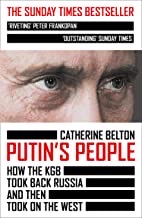
All of this is graphically exposed in Catherine Belton’s meticulously researched anatomy of the Putin regime – Putin’s People: How the KGB Took Back Russia and Then Took on the West, which convincingly shows how western governments that like to preach the rule of law and the benefits of free markets have turned a blind eye to the plunder of Russian businesses by the Kremlin and its allies.
Belton’s book outlines how western companies rushed to sign new deals that legitimised the proceeds of these corporate raids, while our banks laundered the Kremlin’s dirty money, allowing it to penetrate the economies of Europe and the US.
What Belton says about the Blair years matches the conduct of each of the governments that followed his: “Tony Blair’s government seemed to have given the order for London to throw open its doors to Russian money, regardless of its provenance.”
The British political and professional class has then shown itself to be especially greedy where Russian money is concerned. It has appeased Putin’s malign activities for years, with many of its elites happily throwing in their lot with him (about this, see this recently published article in Foreign Affairs:
https://foreignpolicy.com/2022/02/15/gerhard-schroder-gazprom-russia-tony-blair/).
This doesn’t render misdirected their anger about the conflict Russia has initiated.
But it does cause this sceptic to query their immediate reaction to it, cynically wondering in particular if they will comprehensively make Johnson’s sanctions stick.
After all, they didn’t after 2014, following Putin’s earlier military incursion into Ukraine.
As former Tory Attorney General, Dominic Grieve, writing in the Sunday Observer last weekend, said: “our efforts to root out the corruption and sanction those with links to Putin [since then] have been woefully inadequate.”
I am equally nervous about the West’s ability to help broker and maintain a decent peace once the shooting stops.
While Putin will have to play a role in this process, there is no evidence currently available to suggest he can be trusted, which may mean the West has to bide its time before making hard plans, pending him voluntarily leaving office or being forced to stand down. Some pundits speculate this may be within two years. The West needs to bear this likelihood in mind before rushing to bolster their defence budgets, which Germany is already committed to.
Which leads me to ask if the West can be relied upon to express sufficient understanding, even clemency, in building a new peace, given its arguably insensitive approach to the expansion of NATO following the dissolution of the USSR during the period 1998-91, which Putin has described as provocative and threatening. I am concerned that the West will repeat this error of emphasis, particularly if it shortly fast tracks the applications to join NATO of other nations close to Russia’s borders.
One doesn’t have to be a Putin apologist to appreciate this point, as David Allen’s letter published in the Guardian the other day explains: “Putin is Russia’s disastrous response to the triumphal advance of NATO and the EU across the old Soviet fiefdoms of eastern Europe. Nelson Mandela, uniquely, understood that it is crucial for victors to be magnanimous, to offer friendship to those they defeated, and thus seek to avoid renewed conflict. We have not learned from him. Putin is a monster. But we, the West, were the midwives at his birth.”
This doesn’t justify Putin militarily invading a neighbouring country, let me be clear.
Rather, it provides important context and background, whose nature needs to be recognised by NATO’s architects in the next phase of their thinking.
Absurd though it is to imagine, they might for example contemplate the outrage that would arise if the PRC built an impressive military alliance implicating Canada and Mexico. Beijing’s argument that such an alliance, like NATO’s, merely serves a defensive purpose would rightly not be found compelling.
These are not irresponsible, wildly Leftist, Stop the War, thoughts of mine, as a few of my critics have irritatingly described them.
On the contrary, they are one side of a complex debate which needs open-mindedly to be entered into rather than peremptorily brushed aside (see, for example, Professor John’s Mearsheimer’s Foreign Affairs article ‘Why the Ukraine Crisis [of 2014] is the West’s Fault’, which he speaks about in this YouTube lecture: https://www.youtube.com/watch?v=JrMiSQAGOS4).
If the West has made mistakes, and Mearsheimer thinks it has, it needs, I am saying, to make sure it does not repeat them.
What worries me at the moment is that the West’s reaction to the conflict is excessively revengeful and insufficiently cultural. That’s understandable; but it’s not a basis for stopping future wars.
Also, if our values are truly under threat, as many of the hawks and retired generals say, it would help if we practiced them a bit more consistently.
One of the Russian bankers interviewed by Belton wasn’t joking when he remarked that “it turned out everything depended on money, and all those values were pure hypocrisy”.
My critics then have rightly challenged me to spell out what I think Britain’s immediate response to Russia’s invasion of Ukraine should be.
My list of actions includes some don’ts as well as dos:
(1) Take care not to close off too many avenues of diplomatic exchange, although efforts arguably should be made immediately to suspend Russia from being a permanent member of the UN Security Council. Isolating Russia is no bad thing; totally excluding it is.
(2) Convene talks with the leaders of China, India and UAE with the aim of using each as a broker in negotiating a peace deal. China has already declared a willingness to mediate. Britain should encourage it immediately to act upon this good intention.
(3) Tone down the warrior rhetoric. Prioritise instead discourses that emphasise bringing the war to an end rather than encouraging it to continue. Do not then offer verbal sustenance to private citizens who want to join the fighting. Instead, assertively deter such behaviour.
(4) Make clear that Britain would not support any military involvement on the part of NATO, including enforcing a ‘no fly zone’ over Ukraine, which President Zelenskiy this afternoon requested. If agreed to, the results of such an action would be uncalculatable and potentially very dangerous for world peace. Zelenskiy should be told bluntly that his request won’t be acceded to and that he should stop making it, for it is irresponsible. He should be cautioned too that the inclusion of Ukraine in NATO after hostilities have ceased may not be in the interests of world peace. Similarly, promptly admitting his country to the EU might also not be a wise move.
(5) Stop sending weapons to help prolong the conflict, particularly in the absence of trainers to teach volunteer territorial defence units how to use them. To do otherwise is also irresponsible.
(6) Totally remove Putin’s influence domestically, financially, and politically from Britain, including all sporting and cultural ties. In particular, immediately freeze all Russian assets held here; cut out commercial contact and dependency on Russians; and require any Russian citizen whose presence is not judged to be conducive to our public interest to leave.
(7) Put in place a comprehensive programme to provide sanctuary to all those displaced by the conflict who choose to come to the UK to escape from it.
(8) Identify a huge sum of public money to aid Ukraine’s efforts to meet the immediate and on-going medical and general humanitarian costs of the conflict.
(9) Prepare now for post-conflict discussions. And don’t just assume these should centre on enlarging the West’s defence budgets. Deterrence is not the only way to maintain peace. Mutual respect of differences and understanding of their implications should feature as well.