Monday 20 December 2021: Sad to report, but it is looking very unlikely, given the rapid spread of omicron, I will be flying to NYC early in the New Year, which among other things means I won’t see face-face, Renée, my granddaughter, now nearly 7 months old. This photograph of her, taken a few days ago, gives a good idea of what I will miss:

My Quote of the Day: “Getting started, keeping going, getting started again – in art and in life, it seems to me this is the essential rhythm not only of achievement but of survival, the ground of convinced action, the basis of self-esteem and the guarantee of credibility in your lives, credibility to yourself as well as others.” – Seamus Heaney, Graduation Ceremony, University of North Carolina, May 12, 1996.
Between Monday 13 and Thursday 16 December 2021 I attended a mostly silent and largely solitary retreat at Worth Abbey in West Sussex, a community of Roman Catholic monks who follow the Rule of St Benedict.
It felt on arrival a familiar place, probably because Worth Abbey featured centre-stage in the BBC2 documentary series The Monastery first broadcast in August 2004, which I enjoyed viewing at the time. (It’s still available on YouTube.)
The TV retreatants set out to discover whether the Christian monastic tradition offered insights and values that could accompany them through life in the secular world. Despite initial scepticism on their part about that, several discovered this to be the case.
Me? I didn’t go to Worth Abbey for that purpose, for I have never doubted the value of the religious, Christian-specific, life, either full-time within or part-time without a monastery.
My doubts have always centred instead on my ability, or lack of it, to do adequate justice to my faith – to respond well enough to its call in terms of how I live my life and undertake worship and related devotions.
I have allowed other things to get in the way of adequately living religiously, particularly career, political activism and hobbies; and I have made up excuses, notably intellectual ones, for neglecting the process.
And, like many critics of the Church, I have used its institutional weaknesses, which are undoubtedly numerous, to justify keeping it totally at arm’s length, forgetting that all of the bodies I have otherwise mostly happily associated with, and to which I have regularly given the benefit of the doubt, have their faults too. Don’t get me started on the Labour Party, for example. Or the English school and university sectors.
True, none of these organisations, unlike the Church, has self-consciously tortured or sexually harmed anyone. But, just as Stalin’s Gulags do not define communism, nor does the Spanish Inquisition sum up Christianity. 
My purpose in retreating to Worth was not then to reboot my faith, which has been largely intact since I first embraced a form of it in my early teens, but to refresh it – specifically, to give my reaction to its demands a new lease of life; and to learn better ways of responding in worship, prayer and reading to its devotional requirements.
It’s also fair to say that my retreat was, to quote one of the abbey’s monks, “a good way of getting away from the money-making version of Christmas”.
At Worth I fell in immediately and totally with its Liturgy of the Hours, which meant I spent a lot of time in the Abbey Church, taking part enthusiastically in each of its daily – Psalm-based – offices (Matins, Lauds, Midday, Vespers and Compline), with Mass in the afternoon and Lectio Divina in the morning.

After two days of this, I felt very much ‘at home’, which is a notion I meditate on a lot in my normal devotions – “He keeps me safe in his shelter” (Psalm, 27,5).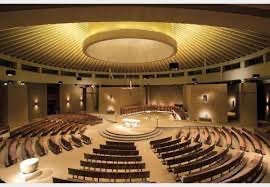
Feeling ‘at home’, of course, is what Benedictine monks strive hard to create in their houses – what they define as ‘stability’.
Following St Benedict’s Rule helps them to achieve it.
If you’re interested to know more about this, see what I’ve written about it on the Church page of this website.
Just scroll down until you reach the section about The Way of St Benedict (it’s after the one on John Henry Newman).
Designed to encourage sound interpersonal and institutional habits – what Rowan Williams calls a “prosaic settledness” – Benedict’s Rule helps to create “heaven in and through the ordinary” (George Herbert).
I also learnt at Worth some new ways of approaching Lectio Divina, a prayerful resource which I have rarely made the most effective use of, entirely because I find it hard to read Scripture without ‘studying’ it. 
Fr Martin referred me to something a favourite theologian of mine, Dietrich Bonhoeffer, once wrote about how to read Scripture more openly, without prejudice: “We ponder the text on the strength of the promise that it has something utterly personal to say to us for this day.”
Fr Martin also gave me some very helpful advice about my personal prayer life in general, which I often think is very inadequate, because it lacks sufficient structure and content: “Pray as you can, not as you can’t”.
Lectio Divina caused me to re-read a favourite verse in St Paul’s Letter to the Romans: “When God speaks, his word calls into existence things that do not exist” (Chapter 4,17).
My recently written essay, ‘On Wording the Unwordable’, I have decided, is a long footnote to this verse. It can be read HERE
On Tuesday I joined in the monks’ celebration of the ministry and poetry of St John of the Cross, recalling this famous line from (I think) his Spiritual Canticle – “Seek in reading and you will find in meditation; knock in prayer and it will be opened to you in contemplation.” Very relevant to Lectio Divina, I concluded.
And I learnt more about St Lucy. whose martyrdom was recalled the day before, about whom previously I had known next to nothing, excepting she plays an important role in Dante’s Comedy, in which we are told, among other things, she carries a sleeping Dante to the entrance to purgatory, bearing a light to illuminate the way. Dante’s allusion is well made, it seems to me.
Fr Mark (Barrett), one-time monk at Worth, has written a wonderful set of reflections on the daily office which I re-read during the retreat.
Rightly, his book has been much acclaimed by reviewers, which include non-believers.
I was interested to discover many insights in it which first time round I had not noticed, like for example the link Fr Mark makes between Compline and the end of life.
Sunday 24 October 2021: It’s been nearly four months since I posted anything new on this weblog. That’s quite a time, given my original plan to write new posts regularly and frequently.
What’s happened to make this plan redundant?
A great deal, is the short answer, which added together has caused me to neglect writing posts in favour of doing other stuff, like going away for two fortnight-long bike-riding, church-crawling breaks – one to Sussex (10-24 July), taking in Chichester, Lewes, Worthing and Arundel), the other to Anglesey (1-12 August), visiting Caernarfon, Bangor, Penmon, Portmeirion and Almwch.
Then (daughter) Chloe and her husband, Jonny, with my new, not long born, granddaughter, Renée, all recently arrived from NYC for an extended stay in the UK, visited for a week in September, to be joined for a couple of days by (son) Jake and his wife-to-be, Amanda, coinciding with my 74th birthday on the 11th.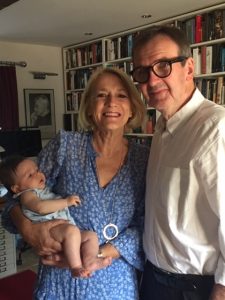

My churchmanship has also proved very distracting: mass on 18 Sundays After Trinity to occupy me, plus nine Saints Days, one of which, on the 28th August, celebrating the life of Augustine, encouraged me to re-read Rowan Williams’s theological study of his work which I liked even more this time round. It’s very good on Augustine’s thinking on language, which is very ‘modern’, suggesting that ‘God talk’ is about ‘wording the unwordlable’.
 And other serious books have grabbed my attention, distracting me from writing posts, like Robert Douglas-Fairhurst’s unusual year in the life of Dickens (a birthday gift from Jake and Chloe); Frances Wilson’s highly original biography of D H Lawrence, which initially I found a little too idiosyncratic (her use of Dante seemed unnecessary to me), but grew to like a lot after half-way; Ross King’s very unexpected history The Bookseller of Florence; Steven Isserlis’s short engaging companion to Bach’s cello suites; Susan Tomes’s sometimes idiosyncratic history of the piano in 100 pieces; Prue Shaw’s eloquent introduction to Dante’s The Divine Comedy; and the second volume of William Feaver’s hugely gossipy biography of Lucian Freud, which I admit to skimming, selectively picking out those topics from its index that especially interested me. But, then, it is a very fat book at over 500 pages.
I have also struggled to get off my desk a new ‘religion’ chapter, which is the 13/14 of my memoir sequel, Memories are Made of This, which I should have finished ages ago, but found myself bogged down with, entirely because its thesis on the role that poetics can play in making religious language meaningful proved too difficult for me straightforwardly to put down on paper, seriously exposing in particular what I didn’t know about the poetry of each of George Herbert and Gerard Manley Hopkins, which I thought I was very familiar with. However, after initially biting off more than I could chew, I managed, thanks to some extra reading, to get the final sections written. Normally, I can draft over 500 words a day. On this occasion, in the later stages, I was reduced to a fifth of that, with much rewriting. Blood out of a stone stuff, in other words. If you’re interested, the whole thing can be read HERE.
My political activism has also kept me away from attending to this blog: a new edition of The Green ‘Un, the village newsletter I write, self-publish and distribute was issued a couple of weeks ago (SEE IT HERE); three Parish Council meetings have required my attention; the Council’s latest bulletin was written and delivered; and I helped coordinate an Eco Fair in nearby Wetherby.
The Labour Party? Nothing much on that front, sad to report. But then its shift back to centrist ways is never likely to sit comfortably with my sort of socialist leftism, though I did do some canvassing in July during the Batley and Spen by-election, which was not a good experience, despite the narrow win which resulted, the bad feeling on the doorstep being palpable at times. I was rarely greeted warmly.
More pleasurable distractions included resuming playing competitive chess, though with very indifferent results (my promotion to the ‘B’ team means I must now play against better opponents than I am normally used to, each of whom this season so far has made my life OTB very hard); watching some dramas on the NTatHome website, including a wonderful production of Sophocles’ Antigone; and listening to eight newly acquired CDs of classical piano music – the best of which I have decided is Víkingur Ólafsson’s Mozart & Contemporaries (DG 4860525). To check my positive assessment of it out, sample some of the disc’s tracks here: https://www.prestomusic.com/classical/products/8935791–mozart-contemporaries
I haven’t been to a single live concert of music for over a year now, deciding that I ought not to with the pandemic still raging, until that is I have had my booster jab which will be in a less than a fortnight’s time, on 4 November.