Categories
Uncategorized

November 2024

Friday 15 November 2024: As is always the case, he beats me to it, by whom I mean Rowan Williams, my favourite Christian theologian-philosopher, who in the current edition of the Times Literary Supplement singles out as his ‘Book of the Year 2024’ the same one I would identify if I was asked – Charles Taylor’s Cosmic Connections: Poetry in the Age of Disenchantment (Harvard).

Rowan says this about it: “Charles Taylor, still impressively active in his nineties, has added another enormous volume to his long succession of magisterial studies (including Sources of the Self [CUP, 1989] and A Secular Age [Harvard, 2007]) in the making of the modern imagination.”

I couldn’t agree more. Not least as I have read with huge profit both of the earlier books by Taylor which Rowan mentions, and several others, notably The Language Animal (Harvard, 2016) and his super survey of Hegel’s philosophy (CUP, 1975). All I know about Hegel, which I like to think is a fair bit, I owe to Charles Taylor!

Rowan sums up Cosmic Connections in a way I wish I could, which is why I will quote him further in full: “[It] muses on the rise and fall of a particular model of the mind as a solitary device for processing atomized elements of data delivered from outside, so as to optimize our use of the raw stuff we confront. From very early on this “disenchanted” picture has had passionate critics. Taylor tracks this critique from the first Romantics through to T. S. Eliot and Czesław Miłosz, with close readings of a range of poetry in English, French and German. This is a brilliant diagnosis of some of the most corrosive weaknesses of modernity – political as much as literary.”

Yep, that is Cosmic Connections in a nutshell. While a long sprawling book (nearly 600 pages) – because it does lend itself to speed reading, it took me ages to get through –  it is rarely dense and regularly illuminating. Its chapter on T. S. Eliot is very good, I think. The one on Gerard Manley Hopkins sadly less so for  it seems to this reader of it not to rely enough on relevant secondary literature. But this is a minor quibble of mine because the overall impact of Cosmic Connections on me has been hugely positive. 

Here are ten sets of words from it which I have copied out because I agree with them and because I think they are worth having a discussion about. They also provide a sense of what the book is about:

“Art yields not just insight, but a strong experience of connection – it transforms our relation to the situation it figures for us” (p.18)

“It is not clear that all facets of human life can be understood within the terms set by natural science . . . Phenomena like value, morality, ethics, and the love of art seem to require explorations which can only be carried out in vocabularies which are validated or not in hermeneutic terms” (p.47)

“The poet is not a simple observer; s/he connects with the scene” (p.51)

“The best art always has a depth dimension” (p.71)

“The modern development of rationality and instrumental reason has alienated us both from own emotional nature and from the Nature we live in. Our destiny is to heal both these rafts together, which involves restoring harmony between human beings in society” (p.96)

“We need a relation to the world, the universe, to things, forests, fields mountains, seas, analogous to that we have to human beings we love and works of art; where we feel ourselves addressed and called upon to answer” (p.130)

“Western epistemology has tended to sideline much of what happens in our encounter with things to concentrate on the takeaway message . . . Poetry goes beyond epistemically driven prose . . . It enters a new terrain, which involves a break with the primacy of mapping” (pp.170, 175 & 177)

“There is an exhilaration in liberation through poetry, which is lacking in clinical description” (p.285)

“History seems to offer no guarantee that the forces of light will always prevail” (p.564)

Advances in justice have to be accompanied by forward steps in reconciliation” (p.575)

Thursday 7 November 2024: Trump back in the White House. Gawd help us all! How could the American people make such a disastrous decision?

These e-mail words, written by a mate of mine, were received by me earlier today, to which I replied: Because, Alan, they weren’t taken in by the ‘trickle down’ nonsense you economic liberals wrongly assume floats all boats. Despite Joe Bidon’s assertion that ‘democracy’ was on the ballot paper, it wasn’t. High grocery bills and poor health care provision, on the other hand, were.”

Instead of promising greater social and economic democracy to the economically left behind, Kamala Harris’s campaign was premised largely on the ‘defend democracy’ sentiments of affluent suburbanites. Rightly, this stress on ‘democracy’ did not cut through to the marginalised and less well-off. Why should they care when it doesn’t deliver on their felt needs and relieve them of their lowly circumstances? Indeed, why should it matter when Harris’s party is itself hardly an embodiment of it, as Dennis Broe explains HERE

Martin Kettle in this morning’s Guardian, however, agrees with Alan, thinking that American voters have lost their senses: [They] have done a terrible and unforgivable thing this week. We should not flinch from saying they have turned away from the shared ethos and rules that have shaped the world, generally for the better, since 1945. Americans have concluded that Trump is not ‘weird’, as it was briefly fashionable to claim, but mainstream. Voters went out on Tuesday and voted weird in huge numbers.

Really? The implication in both Alan’s and Martin’s comments is that 73 million Americans are thick suckers. (I recall something similar being said about the 17.5  million people who voted Leave in the UK’s 2016 EU referendum.) For sure, some are. But all of them?

Maybe a large percentage of Trump’s supporters were more angry than daft; and maybe they thought the Democrats were out of touch and not on their side. A middle-aged woman voter  possibly was speaking for many of them when she said, I’ve been a Democrat my whole life, but I haven’t seen any benefit from it.

Jeff Balls of the Community Alliance for the People remarked similarly: Harris wasn’t really speaking to the people’s issues. I felt like most of her campaign was mostly about blaming Trump.

And the US columnist, Glenn Greenwald. had this message for her: You and the corporatist and militarist party you lead just got your ass kicked all up and down the US, because Americans see that you only care about enriching yourselves at the corporate lobbying trough, If the humiliation you just suffered doesn’t usher in some humility and self-reflection, nothing will.

Bernie Sanders in this open letter published earlier today agrees:

It should come as no great surprise that a Democrat Party which has abandoned working class people would find that the working class has abandoned them. First, it was the white working class, and now it is the Latino and Black workers as well. While the Democratic leadership defends the status quo, the American people are angry and want change. And they’re right.

Today, while the very rich are doing phenomenally well, 60% of Americans live paycheque to paycheque and we have more income and wealth inequality than ever before. Unbelievably, real, inflation-accounted-for weekly wages for the average American worker are lower now than they were 50 years ago.

Today, despite an explosion in technology and worker productivity, many young people will have a worse standard of living than their parents. And many of them worry that Artificial Intelligence and robotics will make a bad situation even worse.

Today, despite spending far more per capita than other countries, we remain the only wealthy nation not to guarantee health care to all as a human right and we pay, by far, the highest prices in the world for prescription drugs. We, alone among major countries, cannot even guarantee paid family and medical leave.

Today, despite strong opposition from most Americans, we continue to spend billions funding the extremist Netanyahu government’s all-out war against the Palestinian people which has led to the horrific humanitarian disaster of mass malnutrition and the starvation of thousands of children.

Will the big money interests and well-paid consultants who control the Democratic Party learn any real lessons from this disaster campaign? Will they understand the pain and political alienation that tens of millions of Americans are experiencing? Do they have any ideas as to how we can take on the increasingly powerful oligarchy which has so much economic and political power? Probably not.

Jason Cowley, editor of the New Statesman, isn’t someone I often turn to for political insight, but his editorial on Trump’s victory isn’t I think far wrong: Kamala Harris was the ideal candidate for Donald Trump: a West Coast liberal lawyer with a rictus smile, an undistinguished record as vice-president, and an opaque policy platform. She smiled and laughed a lot during the campaign, she preached progressive orthodoxies, she rallied with Oprah Winfrey, Beyoncé and Lady Gaga, as if the showbiz elite could persuade provincial, working-class America to vote for the Democrats. The truth is she had nothing to say to Americans disillusioned by economic hardship, alarmed by immigration and the porous southern border, and alienated by identity liberalism.

Team Starmer must surely beware. For if voters here don’t soon experience in their daily lives evidence that Labour is fixing the problems that make their lives shorter and meaner they will rightfully look at what other parties have to offer, even entertain more extreme alternatives.

Team Starmer should then consider shifting its focus away from GDP – ‘growth, growth and even more growth’ – to living standards and the quality of people’s lives more generally. 

Sunday 3 November 2024: Today, at St Wilfrid’s Church, Harrogate, I attended a solemn All Souls’ Day Requiem Mass, recalling positively during its liturgy the memory of deceased people for whom I had a deep affection when they were alive – my father, Dorothy and Patrick Eavis, Paul King, and Christopher David among them.

Although All Souls’ Day is a prescribed commemoration in the RC church, it isn’t in the Anglican communion, excepting in churches like my own, which is Anglo-Catholic. The result is that observance of All Souls’ in mainstream CofE churches is not widespread.

And its reputation among atheistic secularists is not high either. They associate All Souls’ with superstition, particularly at that moment in the liturgy dedicated to prayers for souls said to be trapped in purgatory. This happened today immediately after the homily when the preacher-celebrant said, “Let us commend to God those who journey into his nearer presence”.

I did not say “Amen” to that because my Christian understanding of eternal life (set down HERE) excludes any suggestion that after I die my soul (I will say something about that notion later) is transported to a non-material holding place where its heavenly worthiness is tested and improved.

In my theological book, a state of eternal life is not journeyed to after I die. Rather, it is embraced long before my death day in proportion to the extent to which I live in God’s image, It’s why I always say this prayer under my breath at the end of Mass: “God give me the will to live each day in life eternal”.

I am also hostile to the non-inclusive requirement – equally set down in the liturgy – that the deceased prayed for on All Souls’ must each be members of the “faithful departed”. Those without faith don’t qualify. 

Several of the people on my prayer list this afternoon, additional to the ones I named at the start, would not lose any sleep over that because they’d be very annoyed to think I thought of them as members of “the faithful departed”. Each trenchantly ignored the church’s doctrines and services, while intellectually finding theism, including my own non-literal version of it, so much bunkum.

I like to imagine however they still wouldn’t mind the fact that I recalled them thankfully and supportively this afternoon. All the believers and unbelievers I prayed about today lived lives extremely worthy of emulation, aspects of which they generously gifted me, helping to construct my identity in a fashion that would have been impossible without their assistance. In different ways, they each helped me to be more God-like, which is Good.

In the Thomist theology I subscribe to, all Good comes from God. Accordingly, the Goodness they embodied came, unacknowledged by them, from him. During Mass today, I accredited and gave thanks for that, praying in each case that their example will continue to influence for the better the conduct of my life going forward.

But, no more than that. The idea that they might each be in that holding place called purgatory I mentioned before, and that I could help them in my prayers better to get out of it, didn’t once cross my mind.

I am sure most Roman Catholics, and some Anglo-Catholics, reading the previous paragraphs would consider my conduct at Mass today to be profoundly unorthodox, even an abuse of the liturgy.

Unlike me, they take the idea of purgatory very seriously, including literally. Today’s preacher did, that’s for sure, telling us all at one point that several passages in the NT unambiguously justify the idea of intercessional prayer for souls that are ‘alive’ in an interim state after death in a place of torment.

I don’t consider such passages do any such thing. And I also don’t think Scripture in any event works like that. Yes, it has its own special cosmology, But It is a pre-scientific one in which, as far as I can tell, purgatory does not even play a straightforward obvious part. But that’s another story for another time.

There’s also tied up in this mix the vexed idea of ‘soul’, which the notion of purgatory interprets as some kind of disembodied essence. Again, there is a big argument behind all of this which I can’t go into here.

My conclusion to it however goes summarily like this: soul is not separate from the body (Plato’s view), though (after Aquinas) it does have a special form constituting that immaterial part of me that makes me me (look, I know this is not straightforward), which is not distinguishable from my body; as such, my non-material soul and my physical body interact, each being the flip side of the other; I don’t so much then have a soul as exemplify having one in what I say, do and think during my lifetime; after death, this soul ‘lives on’, chiefly in memory and in various significant ‘deposits’ left behind. This website is one of mine. Another is my children. There are others, which I also won’t go into now.

On All Souls’ Day today I therefore recalled approvingly the souls of individuals whose material lives have ended, but whose lifeforces positively survive, both in my life and in the lives of those theirs lovingly touched.

Theologically speaking, the Mass also enabled me to give voice to the idea that Goodness never dies, confirming my belief in the possibility of an eternal life unrestricted by the material one I am living in the here and now. What I mean by all of this is set down in that link I mentioned earlier – click HERE.

In these disenchanted secular times of ours, which have largely lost any sense of the divine, I am struck by how few public opportunities there are collectively to remember the dead in the spiritual fashion I did today, unless you count Armistice Day as one, which I don’t, thinking it is more these days to do with showing off national pride – a showcase for British patriotism – than corporately grieving over those killed in battle since 1914.

.

The Polish philosopher, Leszek Kolakowski, once said that “culture, when it loses its sacred sense, loses all sense”, I agree, which is why attending the All Souls’ Requiem Mass at St Wilfrid’s this afternoon added lots of spiritual value to the material life I mostly lead.


Categories
Uncategorized

Thursday 3 October 2024

Friday 25 October 2024: Today is the 30th anniversary of my father’s death. This post is dedicated to his memory, which will be formally acknowledged over this coming weekend in the liturgy of a Solemn Requiem Mass at St Wilfrid’s Church, Harrogate.

Friedrich Nietzsche once said that if you haven’t had a good father you’d better invent one by becoming a father to yourself. Stephen Dedalus, James Joyce’s anti-hero in Ulysses, knows this sentiment only too well as bitterly minded he seeks to find a surrogate father to replace his natural one – a man who has declined into bankruptcy and drunkenness. Stephen’s search is highly symbolic, for a family without a father is Joyce’s analogy for an occupied Ireland without its own natural leaders.

I have enjoyed far more luck. For my father, who was born in Ireland in 1912 and died aged 81 in England, is someone with whom I was never at odds, despite feeling I never ever got to know him personally that well. That’s not unusual, of course. But, in Dad’s case, there was more to the matter than immediately met the eye, as I have written about HERE

It’s not that Dad was secretive; more that he was a discrete and very private man. Also, England, to where he emigrated, aged 19, in 1931, was not then a very Ireland friendly country. I suspect English anti-Irish prejudice caused Dad to keep his ethnicity, and himself more generally, under wraps, certainly initially. 

In these more tolerant times, I don’t feel any need to, which is why I will shortly follow closely the ins and outs of the Irish general election, which is likely to take place sometime next month. Already I have a keen appreciation of the issues that will feature prominently in the campaign – housing, health care, and immigration. Familiar, eh? And I have a good idea what the result will be – a version of what Ireland already has, which is coalition government in which FF and FG share most of the power. 

The ‘Irish situation’ (Conor Cruise O’Brien) matters a lot to me, in other words. It’s why I read The Irish Times most days. It also concerned Dad, but not in such a self-evident fashion. It was spoken about by him, but always somewhat behind his hand and only occasionally. Although a cultural Catholic, he also never initiated me into any of it. I did that .

As a boy and young man, I nonetheless looked up to and admired my father enormously. Gentle, softly spoken, and virtuously uncomplicated, Dad was an excellent role model: he earnestly worked hard, always finished things, and he was kind, generous, and prudent. He’d never let anyone down. Read this EULOGY to find out more.

Two of the photographs which illustrate this post picture Dad as I knew him. The portrait at the top – an excellent likeness – shows him not long after his retirement, aged 68; the one of him reading a newspaper (like me, he rarely missed an opportunity to keep up with current affairs), taken in his mid 70s, also captures Dad perfectly – in retirement, he wore a tie only occasionally, liked red socks, and enjoyed sitting outside.

The image below shows me behind Dad’s gravestone at the  Sacred Heart Church in Rathgormack, which is the small village in Co.Waterford nearest to where he was born..

The next photograph shows me with Dad after my PhD graduation ceremony at Lancaster University on 4 December 1984. Although bemused by the proceedings, he took huge pleasure in my success that day, which is evident in his smile. Notice – Dad is sporting  a tie, which, as I’ve said, is not something he did that often after retiring. Like father, like son!

The photo immediately below shows me and Dad (wearing another tie!), above Bath, on Beechen Cliff, in 1951. I am 4 years old; he is 40. It must have been taken on a Sunday morning, which is when he sometimes required me to accompany him on a local walk. I wonder who took the photograph. It can’t have been my mother, who hadn’t a clue about how to operate a camera. Dad did.  

The next photo was taken in the early 1980s, during the time I was a graduate student at Lancaster University:The last photo below, taken sometime in 1936, somewhere in India, shows Dad, aged 24, in the uniform of the Royal Horse Artillery. His career in the British Army, which took him to Middle Asia, the ME and Europe, lasted for over 20 years, details of which, including his time as a POW, can be read about in this EULOGY

Tuesday 15 October 2024: Well, I wonder what you made of it, by which I mean the Labour government’s first international investment conference held yesterday in London.

Listening to some of the interviews and keynote speeches coming out of it I was reminded of Mark Fisher’s short (2009) polemic Capitalist Realism: Is There No Alternative? which includes these two memorable sentences: “it is easier to imagine the end of the world than it is to imagine the end of capitalism. There exists a widespread sense that not only is capitalism the only viable political and economic system, but also that it is now impossible even to imagine a coherent alternative to it”.

(Oh, Mark, why did you have to leave us so soon? Click here:https://www.newstatesman.com/culture/books/2022/11/mark-fisher-capitalist-realism-k-punk-alex-niven)

Capitalism was not just the only show in town yesterday at Labour’s conference; its version of political economy was embraced enthusiastically by Team Starmer, whose approach to managing the UK economy over the next five years and more will be, it’s clear, if it was ever thought to be otherwise, unashamedly pro-business and more and more growth focussed.

If one wanted evidence there is no parliamentary road to socialism – and I don’t – then yesterday’s conference surely provides it. For sure, there will be wiggle room here and there for progressive, lefty-like, ideas to make an impact following it. But the overall direction of travel is clear: capitalist realism is here to stay. It is baked in.

What Lefties like me do about that is not straightforward. For to seek ways of ameliorating the worst effects of capitalism’s excesses – which is what we usually do – runs ultimately the risk of colluding with the raison d’etre of capital accumulation. The oppositional actions we perform, not to mention the ones any Labour government legislates for, are usually accommodated by capitalism on its terms not those of its critics.

A problem, eh? Well, it is for people like me. But not of course for capitalism’s champions, who are in the majority, and who have no desire at all to see inaugurated a form of political economy  antithetical to their operations, which they assume, as I’ve said, are the only ones worth pursuing economically. They are capitalism’s ‘realists’, remember. Like Mark Fisher, I think they are dangerously crazy; but then they think he and I are mad extremists.

Mind you, one immediate and easy route publicly to discredit capitalism’s logic is critically to engage with the words and expressions its champions use. Did you listen to some of them coming out of London yesterday?

Their meaninglessness made the parallel ones uttered during the ‘business section’ of BBC Radio 4’s ‘Today Programme’ appear plausible, even attractive. John Crace’s satire in today’s Guardian surely can’t be bettered on this:

Put a whole heap of CEOs together in the same room and you can guarantee that within seconds they will be speaking in a tongue almost no one can understand – about multiplier effects, intangible assets, align adjustments, index numbers, etc . It is a world of cliche and jargon where normal sentences are deprived of internal logic and meaning. Hard to believe, but you don’t become head of a multinational without first having learned to speak Pure Doggybollocks. It is the code that admits you to the club. And it’s a rarefied world where everyone knows their place. The politicians may be in government, but it is the business leaders who hold the real power. This is not a meeting of equals.

How is it possible that the CEO’s of some of the globe’s biggest corporations can speak in such illiterate doggerel but still go on to ‘rule the world’? Beats me.

Why aren’t they called on more to account for the nonsense they utter? And why do successive Chancellors mimic them? Answer: they’re capitalism’s ‘realists’ too.

And what of the verbal sleights of hand on show, the most notable of which surely is to do with ‘stability’ and ‘certainty’. According to the CEOs, they can only do ‘good business’ if governments encourage and consolidate each of them? Eh?  Isn’t capitalism inherently unstable because its markets are precarious and systemically uncertain? As Mark Fisher says, capitalism is by its very nature opposed to any notion of sustainability

What are these people on about? Do they want the world to be ordered by elected governments in ways that allow them to operate with impunity entirely on their terms? I think they do. It’s why they hate governments which restrain through regulation their financial activity. They want to be free to make money entirely on their terms – for themselves and for investors. 

The CEOs at yesterday’s conference aren’t then philanthropists. They are money-making entrepreneurs looking to make returns on investments better than they can get from buying government guilts. They are in it for their good not ours, not society’s. And they expect governments  – Starmer’s government included – to help them by not getting in the way of their kind of ‘progress’ which fosters class power and privilege, inequalities of wealth and income, and worsens the climate emergency.  Why are they allowed to get away with this? Again, it all beats me,

What doesn’t is the need always to be on one’s guard when politicians – of the Right and the Left – embrace fully a pro-business stance, as Starmer did in London yesterday.

Growth, growth, and even more growth are all very fine, providing each is linked to a story about long-term societal wellbeing, which Team Starmer is yet unambiguously to write.

Prosperity only becomes a societal good when it contributes to the common weal – when it floats all boats and not just a few of them.

Thus, you don’t have to be a socialist to expect a Labour government to promote greater equality, improved fairness, and more social justice. As a Labour supporter said in the Guardian the other day: What I expect from a Labour government is that it should always be asking the questions: growth from what? And for whom?

And it’s not unreasonable also to demand that Labour does not legislate in ways that better enable unscrupulous companies to maximise yield while fostering public harm.

The PM yesterday said at one point that “growth leads to a country that is better equipped to come together”. Mmmm? What’s the evidence for this claim? Indeed, is economic growth of the sort he envisages a precondition for repairing the public realm? Some of us aren’t sure it is, you see.

Saturday 12 & Sunday 13 October 2024: This weekend marks Labour’s first 100 days in office since winning the UK GE on 7 July. Why the 100 days marker is highlighted so much in electoral politics has always bemused me – why 100, why not 200, etc?

Historical precedent is the answer. Its origins can be traced back to 1933 and the then US President Franklin D Roosevelt. The 100th day of his presidency that year was 12 June. On the 25th, he gave a radio address to the nation, near the start of which he said: “Looking back, we all wanted the opportunity of a little quiet thought to examine and assimilate in a mental picture the crowding events of the hundred days which had been devoted to the starting of the wheels of our New Deal.”

Since Roosevelt’s time, the first 100 days of a US presidential term has taken on symbolic significance, constituting a benchmark to measure the early success or failure of not just US presidents, but the record of political office holders in other parts of the world.

So, looking back, how should we “examine and assimilate in a mental picture the crowding events of the hundred days which have been devoted to the starting of the wheels” of Labour’s change agenda since it was elected three months ago?

One of my mental pictures looks like this: imagine a headteacher newly appointed to lead a just-opened school. In his/her first term in the role, s/he botches the selection of the school’s senior management team, embarks on introducing two highly unpopular and socially damaging policies, and considers reneging on a pair of commitments made during interview. Don’t you think there’d be calls to ask him/her ‘to consider his/her position’? Or, if not that, there’d be rumblings among members of the interview panel that they’d made an error of judgement in appointing such a person to the role?

This mental picture is benign compared to the one conjured by a contributor to the left-wing Novara Media website, who says: “Over 400 seats at the election with the lowest turnout in British political history against the worse government in British political history. This wasn’t a mandate; it was simply chance; and those 400 seats are built on quicksand due to an electorate dissatisfied with our whole political class. A swing of just 6% from Labour to the Tories would totally wipe out Starmer’s majority. If he had been radical his popularity numbers would have held up. Instead, he appears economically Conservative light. Meanwhile, the working class and the middle class and small to medium sized business class still suffer and will continue to do so under a government that will tinker around the edges without doing anything of real consequence.”

The Guardian’s political editors are kinder, though deeply concerned:“after a bumpy start, there is anxiety that this might be more than the usual stumbles of a government getting used to the vagaries of office, and instead the symptoms of a dysfunctional No 10 operation, and even a lack of political acumen at the top.” They quote a ‘senior Labour source’ as saying, “we all hope it’s teething troubles, but we all worry in case it’s something worse.”

So does the right-wing Spectator magazine which says Labour’s first 100 days “could have not gone worse”.

Well, they could have by a country mile is my reaction to that daft evaluation. Isn’t it good that Labour has settled long-standing pay disputes with rail workers, doctors and teachers? That it scrapped the infamous Rwanda policy for asylum-seekers? And didn’t Team Starmer do well in its response to the anti-immigration riots? And hasn’t it made a good start on planning reform?

Yes, is the answer to all four. But there remains, methinks, a big problem going forward, which the editor of The Economist highlights: “without a compelling analysis of what ails Britain and a clear sense of direction, the wheels of government are more liable to spin. Without a vision of what he wants to do and why, Sir Keir will struggle to avoid being distracted by events or to explain the trade-offs that governing demands.”

Will Hutton concludes similarly: “Part of the problem is that the party’s leadership relegates the importance of ideas and political philosophy because, allegedly, they do not constitute good ‘retail politics’, don’t play well in focus groups, and open up the threat of attack for being of the Left. It is safer to duck argument over ideas and be a managerial party focusing on delivery.

I am rarely on the side of either The Economist or Will Hutton but, on this occasion, I don’t think either is far wrong.

However, I am not optimistic Team Starmer can produce a set of ideas, least of all represent and propagate a vision, that adds up to the kind of socialist one I adhere to and want to see advanced. But then it would be silly of me – and all other Leftists – to expect it to.  

Ours is a capitalist state, and its governments, including Labour ones, get elected to meet and manage its needs and expectations. The Tories, happily the party of wealth and privilege, do this with a relish; Labour, allegedly the party of the underdog, feigns not to. 

Ralph Miliband then was right in 1961; and he’s still right over 60 years later – there is no parliamentary road to a socialist society. Labour governments are disabled ideologically and constrained economically from inaugurating one. It’s an establishment party, not a revolutionary one.

The most that can ever be hoped for from a Labour government then is that it will manage successfully the capitalist state in a fashion that leads to less bad stuff: children in poverty, pensioners dying of cold, low pay, inequality, etc.

A lot in this connection will of course be evident or not in Labour’s first Budget, the content of which we will learn about on 30 October.

This is 117 days since it took office, which I have calculated is the longest interval for a new government to hold its inaugural Budget in over 50 years.

Let’s hope it’s worth the wait. I am not holding my breath.

Sunday 6 October 2024: I flew from JFK to London HR today. An uneventful journey made easiy for me by my new bag carrying assistant:

Since leaving the UK on 27 September, I have had a busy and very enjoyable 8 days staying with my daughter, Chloe, and her family in Brooklyn, NYC: watching baseball for the first time ever at the Yankee Stadium, going to the theatre in Manhattan, visiting the Bronx Zoo, bike riding twice round Central Park, doing the school run and attending Mass each weekday, studying for three whole days in two libraries, reading every day a hard copy of NYT, and hanging out a lot with each of Chloe and Renée.

Today’s NYT is much dedicated to the upcoming presidential election, which is just 30 days away.

It includes a 12-page supplement covering the key issues. Besides a very helpful survey of how 6 key ‘swing’ states might vote on 5th November – which tells us that the outcome in most of them is far  too hard to call – the supplement outlines what is at stake in each of the elections for the Senate and the House.

This indicates the Republicans couldwell retain control of the latter, while conceding a narrow victory to the Democrats in the former. 

The supplement also sets out the stances of each of Trump and Harris on a range of key issues: the climate emergency, crime, abortion, the economy, immigration, and foreign policy, including in particular the war in Gaza and the OWB.

The differences between Trump and Harris on each of them is not as huge as you might suppose. True, they are poles apart on abortion rights; and they don’t agree on NATO and Ukraine.

Otherwise, like on the economy, including taxes, immigration, housing, social security and medicare and foreign relations, there isn’t a lot to divide them.

Although Harris is not remotely a MAGA enthusiast, she supports an active global role for the US, seeing it as the world’s leader in promoting liberal, free market capitalist democratic values.

Trump then is lying when he says Harris is a Marxist! She’s not even that much of a left of Centrist. More like Biden and the UK’s Keir Starmer than Chile’s Gabriel Boric is thus a better description of her ideologically.

Although there is not a huge of difference between the Democrat and Republican prospectuses, this does not hold back the NYT’s editors urging its readers and the wider public to support Harris.

They describe her as “the only patriotic choice for America”, concluding she “has shown care, competence and respect for the Constitution – the fundamental qualities necessary for high office”.

Their recommendation is thus based on an assessment that Harris has the better ‘character’ of the two. And, on that, they must be right. It supports its endorsement by quoting over 90 people prominent in American public life, each of whom consider Trump as unworthy of the Presidency.

Richard Logis, onetime, longtime Trump supporter speaks for most of them, saying, “lying is his toxic superpower”. Meanwhile, Paul Ryan, Republican Speaker of the House from 2013 to 2019, says, “Character is important. It’s a job that requires a kind of character that he simply just doesn’t have.”  

I guess this also explains the NYT’s continuing hostile view of NY Mayor Adams, who it says should resign before his trial.

The NYT carries a poll to support its case, which reports that over 75% of New Yorkers say they want Harris to step down now.

I saw this cartoon displayed in a café in Park Slope earlier today. Am I being an over-sensitive Irishman to think it is a very demeaning (even racist) characterisation of the island of Ireland?

The Irish are happy to laugh at themselves, and do so a lot; but they take offence when other nationalities jokingly construct them as second rate. Isn’t this cartoon doing just that?

Seeing it triggered in my imagination a set of ‘Irish’ questions: does President Biden really have Irish ancestry? does it matter if he does or does not? when will the Republic’s GE be held? and who will win it?

My answers: he does have it; if he doesn’t, then he’s a liar; well before Christmas, probably late November; on current polling, Fine Gael will narrowly win the most seats (an improvement from 2020, when it was the third largest party in Dáil Éireann). But it will have to go into coalition with Fianna Fáil to hold power, ignoring all overtures from Sinn Féin (which surely won’t be forthcoming in any serious fashion), who I predict will in any event lose a little ground.

In other words, Ireland’s next GE is likely to realise a government much like the one which currently rules it. Yawn, yawn. The right of centre will hold.

Categories
Uncategorized

Tuesday 17 September 2024:

Wednesday 2 October 2024: I started today as I ended yesterday – sat on a bike, but with a difference.

There’s a gym in Chloe’s apartment block, which is where, at 6.30 am, I joined a 40-minute long spin class, riding one of those Peloton power bikes. Not ideal cycling, for sure, but a good way to shake off overnight cobwebs.

Last evening’s ride was hugely much better – two laps of the 6.2 mile long circuit of Central Park in Manhattan, ridden with my nephew, Ben, who introduced me to the route 15 years ago.  He took the photograph of me shown below, riding alongside with both hands off his bars, which explains its blurred quality. You get the idea, I hope.

Starting at the Fifth Avenue entrance of CP, the circuit includes a sweeping descent around Harlem Meer, a sneaky, bitter even, climb through North Woods, and a final dash past the Metropolitan Museum of Art.

Click here to view a selection of videos of what the experience of riding the route is like.

How did I find the ride? I enjoyed it enormously, despite being slower off the mark than was the case in 2014, which is when I last did it. This time I averaged 13 mph; 15 back then.

But I didn’t complete the ride this time to achieve a p.b. I rode it just to have fun, with someone I like a lot, and to go down my cycling memory lane. It helped that the conditions were perfect: warm, dry, and with no on-coming wind.

Spin biking, taking Renée to pre-school , and attending Mass got my day started. From 10am, the rest of it was spent in Brooklyn Public Library (I posted some images of this fine building the other day), where I read some more chapters of that book I mentioned yesterday on the moral philosophy of Alasdair MacInytre. It’s reminding me of why I rated him so highly earlier in my life, in the 70s and 80s. I will explain why in a later post.

During downtimes from that book, I read the local press, including the latest edition of Brooklyn Voice (see the photo below) which dedicates 6/23 pages to Mayor Eric Adams’s indictment.

Unlike the editors of the NYT, who want Adams immediately to resign, the BV leader writers think he should stay in post until it can be demonstrated he’s guilty: “No one wants a corrupt leader, but Mayor Adams is an innocent man until and unless he is tried and found guilty – and only then. Any disruptions to regime change should then be minimized, and that means everyone should calm down and proceed in a sensible manner.”

I am beginning to sense the start of a successful fight back by Team Adams, suggesting that my earlier ‘dead man walking’ comment was both false and premature. Indeed, I am now thinking he may well survive!

The headlines in the NYT meanwhile include ones about Iran’s missile attack on Israel (“Air defences blunt barrage”); Israel’s recent attacks of Hezbollah (“Half of Hezbollah’s arsenal destroyed”); Russian advances in East Ukraine (“A long battle nears a sudden end”); Trump’s campaign (“On trail, Trump is increasingly peppering his speeches with doomsday warnings”); and impact of Hurricane Helene (“Leaving ruin in its wake”).

The VP TV debate? Apart from his telling question about the outcome of the 2020 election, Walz I thought side-stepped opportunities to attack Vance more forcefully on other issues, In fact, the latter seized the chance to pitch a gentler version of himself. It seemed to work, if the after-the-event polls are to be believed.

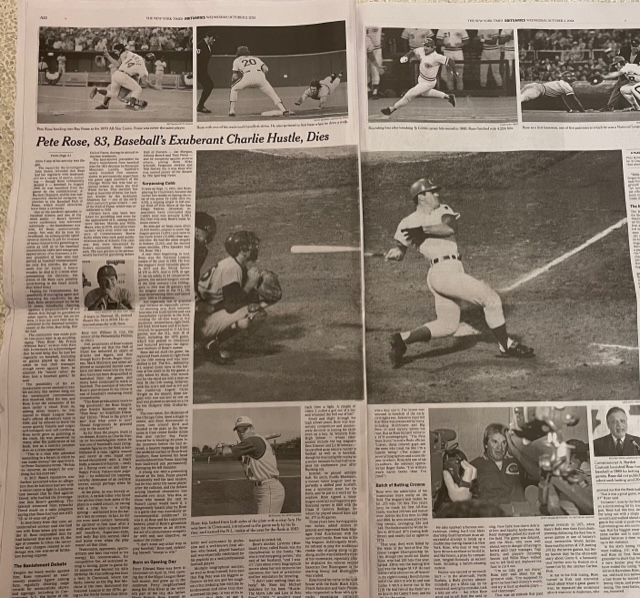
There’s also a double-page spread in today’s NYT on Pete Rose, ex-baseball star, who died on Monday, aged 83.

Despite a record-setting career as a big hitter, Pete was given a lifetime ban in 1983 because of his gambling activities, which were OTT and out of control, crowned subsequently with a short period in jail for tax evasion.

The NYT’s obituarist describes Pete’s moral and professional failings as “exuberant” rather than corrupt or reprehensible.

Pete was of the same mind, saying in his autobiography that, while he let himself and baseball down, that is “no reason to punish me forever”.

I also spent part of today reading the Irish Times’s coverage of Ireland’s Budget, just announced. Its assessment is not positive, even a bit cynical:

“What’s the politics of all this? Giving away a pile of money to voters a few weeks or months before an election is obviously better than doing the opposite. It won’t guarantee anything. But it surely doesn’t do any harm.”

The ‘pile of money’ amounts to  a 14 billion euro surplus in Apple back-taxes, which the coalition government has decided to spend on increased social welfare and higher public infrastructure investment. The surplus also provided it with an excuse to introduce a range of tax cuts. 

The IT’s front page is very concerned about all of this, reporting the criticism of the budget’s measures made by the Irish Fiscal Advisory Council: “Ireland needs a more serious vision that delivers on the economy’s needs without repeating the boom-to-bust pattern of its (Celtic Tiger) past. The large spending increases and ax reductions will drive up inflation, adding an estimated €1,000 to the cost of a typical household’s yearly outgoings”.

Irish Times economics guru Cliff Taylor warns that the “splurge of once-off cash is not a good use of public money … much of the benefit goes to those who don’t need it”.

Fintan O’Toole argues that, while the state has an almost surreal surplus of 25 million euros, it has “no coherent sense of how intelligently to spend it.”

The Irish Times editorial concludes similarly, saying that Budget 2025 is “incoherent and short-termist”.

Ouch! But the IT is right.

Not a chance I am thinking that Rachel Reeve’s UK budget later this month will elicit a similar reaction – she has a deficit not a surplus in her accounts – though it will probably provoke hostile comment from Lefties like me for being far to fiscally orthodox. She won’t mind that, of course.

Tuesday 1 October 2024: A short post today, much of it drafted in the main reading room of the NY Central Library on Fifth Avenue, which is where I spent most of the day studying before meeting up with my nephew, Ben Lloyd, for a bike ride around Central Park.

Do you know the NYCL?  I love it. The two photos below show its iconic front entrance (can you spot the famous lions?) and that main reading room I just mentioned.

Earlier, I dropped Renée off at pre-school, subsequently attending Mass at St Augustine and St Francis Xavier’s where reference was made to the 19C French Saint Thérèse whose Feast Day it is today. Unlike Jerome, yesterday’s saint, I knew nothing about her, only discovering later that she commands a lot of respect and devotion among many Catholics because of her fortitude in coping with prolonged debilitating illness which eventually killed her at a very young age.

Highlights in today’s NYT include lots of front page stuff about US singer-songwriter Kris  Kristofferson who died last Saturday, aged 88. The NYT says his “magnetism commanded the screen” and his songs hugely “broke through”. All lost on me, I’m afraid. I confess I can’t identify one of the films he starred in so successfully or one of the songs he wrote and performed which sold in their millions. Mind you, the fact that they were country & western might have something to do with this as I have never understood or liked such music.

Other headlines: “Israel invades border region inside Lebanon”, “Vice-Presidential debate is chance to help define top of the ticket”; and ‘Portraits begin to emerge of victims of Hurricane Helen’s rampage”. 

The occasion of Jimmy Carter’s 100th birthday caused  the NYT to describe him “as an example of moral seriousness”. I think that is about right.

Meanwhile, by contrast, the beleaguered NYC Mayor Eric Adams says, “I’m not going ro resign – I’m going to reign.” Mmmm? The NYT says he must go, and quickly. NYC’s rich set however isn’t so sure. It rightly fears that if Adams resigned with immediate effect his interim replacement, Jumaané  Williams, the public advocate, would make life hard for its members, which is likely as he is a self-declared democratic socialist.  Williams has also said that in the event that Adams does go he will stand for election to replace him.    

The NYT, I find, is hard even so to place politically. While it’s a Democrat paper, that doesn’t give much away given that that party has some very rightist tendencies running through it. And the paper’s Editors have equivocated on Israel’s conduct of its war in Gaza and OWB: and their hostility to all things China is naively predictably. I often think the NYT is more a right of centre outlook than a left of centre one. A poor person’s Guardian, in other words.

Monday 30 September 2024: After dropping Renée off at her new pre-school for 8.30, I walked to St Augustine and St Francis Xavier’s for 9.00 Said Mass (I plan to attend every weekday morning I’m here), which today coincided with the Feast Day for St Jerome.

Unlike many of the individuals who feature in Rome’s very large Family of Saints, about whom  I am entirely or largely ignorant, I know a fair bit about Jerome: early 5thC Christian priest, theologian, and translator of the Bible into Latin. He also produced a Biblical commentary which features strongly in every priest’s training, explaining why it is often quoted in homilies.

I like a Said Mass: just 30 minutes – no hymns; psalm recited rather than sung; very short homily; few intercessional prayers (which pleases me, because I don’t like them); no collection; no Nicene Creed, and Eucharist received at near halfway. So, a very foreshortened, concentrated, even intense, service, making it easier prayerfully to attend fully to from start to finish.

During Sunday Parish Mass, which lasts twice as long, and sometimes more, I confess that my mind wanders sometimes. I know it shouldn’t, and I do try hard to stay totally in touch with everything that’s going on.

But weakness of will, often exacerbate by a distraction (an unexpected noise, for example), can easily put me off my stride, though never I find after the prayer of the Eucharist.

Whatever, the circumstances, I always attend closely to the readings, which today included one from the Book of Job that pointed up his steadfast devotion to God despite the awful circumstances of his life (Job, 1, 16-22).

Meanwhile, the Gospel this morning, from Luke (9,46-50), had a hard thing to say to Christ’s followers about the importance of avoiding being vain-glorious.

After Mass, I walked round the corner to my favourite newsstand to pick up today’s NYT. It’s now $4 (=£3). Not so long ago it cost half as much. But, no complaints – like the Guardian, it’s cheap at the price. 

A fifteen-minute walk took me to the grand entrance of one of my most-liked places in Park Slope – the Brooklyn Public Library. As the photo above shows, this is a wonderful public building – a NYC designated landmark no less. A four-story Art Deco style construction, opened in 1941, it resembles an open book as viewed from the air. The next photo shows its splendid front doorway.I love studying at BPL, always grabbing a place on the first floor in a large, always quiet, area. It’s shown in the snaps immediately below.

After skim-reading the NYT – catching up on the latest about the campaign for the presidency, the indictment of Mayor Adams, the wars in Ukraine and ME, and the heavy toll wrought by Hurricane Helene in North Carolina – I revised parts of my essay, ‘Two Images of Ireland’ (which took me an hour and a bit – see the result HERE).

I ended my study time re-reading a couple of chapters of Peter McMylor’s (1994) Critic of Modernity, a sociological study of Alisdair MacIntyre’s moral philosophy, whose Marxist-Christian outlook exerted such an influence on me in the early ‘70s, and whose book After Virtue did the same in the ‘80s.  Is MacIntyre still read, I wondered. He ought to be, I concluded. For his Thomism, his rewriting of Aristotle, his Hegelianism, and his excursions into Marxism make him surely still one of liberalism’s best critics. It’s why I am revisiting him now, hoping to rediscover his way of defining a post-liberal moral outlook that renders superfluous the one emerging out of Rightist populism and for which Centrist ideology seems to have no adequate response, other than to bemoan its increasing influence. .

I left the library at 2.50pm. Walked to collect Renée from school at 3.10; then on to Washington Park for the swings, climbing frame, and some biking. Renée, not me! Home by 5pm, via the ice cream parlour. A good day.

Sunday 29 September 2024: I’m writing this in NYC, visiting Chloe, Jonny, and Renée for the second time this year. They live in the Park Slope district of Brooklyn. I arrived last Friday; I leave in 8 days time.

The big city news is the fraud and bribery case against NY Mayor Eric Adams. While he is very busy digging in, including denying all charges etc, I think he is a dead man walking, and will struggle to survive.

The NYT thinks he should resign, arguing that the charges against Adams appear well substantiated.  Adams also has ‘previous’, which is why support for him among fellow Democrats – in NY and beyond – is not noticeably either large or fervent. Team Harris clearly fears negative fallout for its presidential campaign, not least because of Adams’s Trumpian parallels: he’s a showman, a relentless self-publicist, and a promoter of dystopian views, particularly about migrants who he once said were “destroying NYC”. The NYT describes Adams as “the latest worm in the Big Apple”.  Rotten to the core!? 

Saturday’s NYT also published a full page survey of what the IDF is presently up to militarily in the OWB. Chilling stuff – drone attacks, bulldozing of infrastructure, etc – the details of which have not been much, if at all, reported in the British and European press

Yesterday, with Chloe, Jonny, and Renée, I went to watch a National League baseball game at the Yankee Stadium.  This was a new experience – watching a game whose rules I know nothing about.

The Yankees, the home team, lost 9-4 to the visitors, Pittsburgh Pirates. Don’t ask me how, because I can’t work out the way baseball is scored. Indeed, much of what I witnessed yesterday was a mystery to me. So complex. And the weird jargon – just what is a ‘whiff-rate’? Beats me. However, I loved being there at ‘ringside’ to soak up the atmosphere, including the collective fun of it all, excepting the fast food on sale, which was dire and very expensive. But huge larks, otherwise.

This morning, I attended another mystery, which I can make good sense of – Eucharist at Park Slope’s St Augustine & St  Francis Xavier church. It’s where I normally attend Mass when I’m over.

Over 200 at the service, which was conducted by Fr Frank in his usual accurate and dignified fashion. Pity though about the ill-disciplined racket made by several of the young children present, which often made it hard for this mind-wandering worshipper to attend fully to the liturgy. And maybe Fr Frank’s announcement at the end that the Feast of Saint Francis of 4 October will occasion him blessing people’s pets wasn’t his finest moment. What is that all about?

This morning’s Epistle – James 5, 1-6 – had some hard things to say about living a life  dominated by the acquisition of personal wealth, the reading out of which struck me as deeply ironic given that the American Dream is significantly all about precisely that. Fr Frank steered clear of any mention of this contradiction in his homily!

In the evening, Chloe and I went to the Studio Theatre in Manhattan to see James Ijames’s new play, Good Bones, which is a serio-comedy about the tensions gentrification can set off in a Black community. It was well done: some very good writing; excellent acting from an all-Black cast; and a memorable set. It was a ‘busy’ and mostly plausible drama, addressing a wide range of themes and ideas: the nature of community; class division; nostalgia; getting rich quick; urbanisation and identity. 

(Thinking ahead, I must make sure to post something about my father on 25th October, which will be the 30th anniversary of his death date.)

Thursday 29 August 2024: It’s nearly two years since I posted anything on this weblog. This neglect was caused entirely by me diverting all my writing attention to getting off my desk the manuscript of a new book – nearly 90 thousand words of text. A collection of autobiographical essays on a variety of topics, this book has a somewhat sentimental title – Forget me Nots – which betrays badly its actual content, for it is anything but schmaltzy. My plan is to self-publish it before the end of this year. For an idea of what it is about, read this PREFACE

A lot of important stuff has happened in the world and UK since my last post.

During 2022, major war returned to Europe following Russia’s invasion of Ukraine; the door closed finally on US policy of strategic engagement with China; the Covid-19 pandemic eased in most countries; in Latin America, each of Honduras, Colombia and Brazil moved Left politically; world inflation returned; climate change intensified; the UK had three Tory prime ministers in two months and its Queen Elizabeth II died on 8 September, having reigned over us for seventy years .

In 2023, catastrophic natural disasters took place in each of Morocco, Afghanistan, Turkey, Syria, Libya, Malawi, and Mozambique; Russia’s invasion of Ukraine intensified; a major escalation of the Israeli-Palestinian conflict was occasioned by Hamas’s attack on 21 Israeli communities, murdering over a thousand Jews and kidnapping a further 150; COP 28 leaders agreed to “transition away” from fossil fuels; the UK crowned Charles as its new monarch; PM Boris Johnson was exposed as a liar over Partygate; Labour performed well in local government elections in May, winning also a byelection in Selby & Ainsty in July with a near 30% swing from the Tories, which I helped to achieve.

So far, in 2024, elections to the European Parliament brought success for far-right parties; Leo Varadkar surprisingly resigned as Ireland’s Taoiseach; former US President Donald Trump was found guilty on 34 counts in a hush money trial; against every prediction, India’s GE concluded with Narendra Modi’s ruling Bharatiya Janata Party losing its outright majority in the Lok Sabha; Labour secured a huge parliamentary majority following the UK’s GE, though on a mediocre share of the popular vote (I am told that a mere 6% swing to the Tories would wipe it out); Israel’s bombing of Gaza continued unabated; and Ukraine invaded and occupied Russian territory.

Lots of personal stuff of course has come to pass since I last posted. A birth and two deaths, notably. A second granddaughter, Amaya, parented by my son, Jacob, and his wife, Amanda, was born in London on 28 March 2023. Far less happily, Paul King, my favourite teacher from my grammar school days, continuing as a good friend subsequently, died on 11 September 2023, aged 87 (click PAUL KING EULOGY); and Dorothy Eavis, a dear friend, and widow of an even bigger one, Patrick, passed away on 16 April 2024, also aged 87 (click DOROTHY EAVIS EULOGY).

Between 2022 and now, I visited NYC four times to spend time with my daughter, Chloe, and her family, including Renée my first granddaughter (3 years old as I post this); I redeemed a friendship with ‘Alan’ which I had foolishly a few years back brought to a premature end; I acquired a new political soul mate – ‘John’ – with whom I now regularly exchange political messages; I happily re-met Tony and Kathy Webster, old friends from the 80s with whom I’d had lost touch; I spent time with Kate and Anna Eavis following the death of their mother.

Mention of those four trips to the USA prompts me to mention that I will be making others like them to Rome, beginning next year, because my son, with his new family, has just relocated there, to take up a 4-year long posting as First Secretary at the British Embassy.

Less majorly, I navigated the local book club I lead to complete an end-to-end reading of Joyce’s Ulysses. I accompanied Kathryn on two extended campervan tours in Europe, which included checking out places with which Dante was associated including the Scrovegni Chapel in Padua to see its incomparable fresco cycle by Giotto (click this ON DANTE AND GIOTTO). San Zeno’s Romanesque masterpiece in Verona was also visited (for the 2nd time). Attending Mass at Santa Croce’s in Florence was another highlight.

I went to the Bath Mozart Festivals in each of 2022 and 2023, listening also to over a dozen recitals at London’s Wigmore Hall and two Proms at its Albert Hall in the same period, plus local chamber and solo piano events in each of Leeds and Harrogate, often accompanied by Kathryn. The highlight was undoubtedly hearing in February this year over two weekend days a complete cycle of Shostakovich’s string quartets performed by the Brodsky’s at Leeds’s Howard Assembly Rooms.

Kathryn and I also went to some good theatre, including ten Shakespeare’s: Hamlet, The Tempest, Much Ado About Nothing, Richard II, As You Like It, Othello,Macbeth, Merchant of Venice, Julius Caesar and The Merry Wives of Windsor.

I purchased too many CD recordings of classical music – over a hundred since my last post – most of which subsequently I listened to infrequently, excepting Paul McCreesh’s version of Elgar’s The Dream of Gerontius, released in May this year. Going forward, I have decided radically to cut back on what is a form of extravagant consumption, motivated more by obsession than a desire further to educate myself musically. 

My chess career as a club and tournament player meanwhile limped on in its usual way – mediocrity, leavened by the occasional half-clever win – though my BCF grade did go up, but only a very small increase. It’s lucky then I love playing the game and enjoy the company of many of the people I meet when I do.  

I also continued to read a lot of books, mostly serious non-fiction it must be said (I really must read more novels!), with Andrew Davison’s extended study of Aquinas’s theological metaphysics – Participation in God(2019) – and Charles Taylor’s newly issued survey of Romantic poetics – Cosmic Connections: Poetry in the Age of Disenchantment (2024) – being standout texts.

I  matured my faith in other ways – by sampling a pilgrimage to the Shrine of Our Lady in Walsingham, attending Mass regularly, both on Sundays and midweek, dedicating increased effort to undertaking my daily devotions, and going on two solitary/silent retreats to separate Benedictine houses.

In addition, I kept up my shifts at the local foodbank; doorstepped and delivered leaflets for Labour (though not always enthusiastically, given my uneasy membership of Starmer’s ‘changed’ party); resumed attendance at the Oxford Summer School; and rode my bike often, though not as far as that ‘Coast to Coast’ adventure I posted about on 10-12 September 2022. 

Categories
Uncategorized

10-12 September 2022

10-12 September 2022: For as long as I can remember I have been a keen cyclist, stretching back to my early teens when I first owned a racing bike and joined a cycling club.

Although I fully interrupted being a biker in my 20s and 30s in favour of running, my first and most enduring sporting love has been ‘the bike’.

I say as much in a chapter in my self-published memoir, Keep on the Move, where I describe the sport’s attractions and how I first got into it, listing as well the specific ways I have found it enjoyable (read it HERE).

A later page on this website fills out further details, including showing a few photos of me ‘in action’ on the bike at different times in my life.

I am of course not the first person to write enthusiastically about biking as a sport and recreation.

Bookstores confirm as much. Many of their shelves are well stocked with texts dedicated to different aspects: histories, biographies of famous racers, training guides, route surveys, DIY bike maintenance manuals, and much more.

There are even ‘philosophical’ studies about biking, like Fritz Allhoff’s Cycling Philosophy for Everyone, which has chapters in it titled ‘Bicycling and the Simple Life’ and ‘Taking the Gita for an Awesome Spin’.

And there are one or two famous novels that have cycling at their heart, such as Flann O’Brien’s gloriously weird The Third Policeman, from which I like to quote “how can I convey the completeness of my union with the bike, the sweet responses she gave me at every particle of her frame”.

And then there are the numerous magazines, of which Cycling Weekly is still my most favoured read. Parts of it are quite daft; but the overall impact is reassuring and very pleasing on the eye, especially its reviews of new bikes and the latest kit, including gadgets.

Paul Maunder’s recently published lyrical meditation on what it means to ride a bike – The Wind at My Back – corresponds exactly to my experience, especially when he writes:

Cycling is a sport for romantics. Its legends are created through suffering, and whenever you ride a bike you can understand that suffering. . . . . Over the years we build our own personal cycling mythology, a kind of memory bank containing the images that are important to us – epic rides, races won or lost, roads that have punished us. . . . They come with me on every ride.

If some of that sounds a bit grim, consider too, by contrast, that riding a bike is an effective salve for depression, in part because it releases into the body chemicals known to lift our mood – serotonin, dopamine and endorphins. I have also read a medical journal article that says memory, reasoning and planning are all boosted after just thirty minutes on the bike.

That’s never been my experience. Nor have I wished it to be. Indeed it’s the sheer mindlessness of biking that often causes me to want to do it, entirely because cycling allows me briefly to forget my troubles and busy life as I enjoyably seek the distracting sensation of feeling my body in rhythmical movement, which I allow to take me over.

There’s also of course the aesthetic pleasures that riding lovely routes give. The world really does look differently and better when you’re sat on top of a bike, I find.

I agree 100% with Paul about those important images – memories of rides that positively mattered at the time of completing them, which make one feel psychologically good as they are recalled repeatedly to mind, particularly if they entailed a significant challenge that had to be overcome with beyond the normal effort.

The chapter in Keep on the Move I mentioned earlier is full of such images, particularly epic rides I have ridden over the years, like the famous ‘End to End’ (E2E, Land’s End to John O’Groats), which I rode in just over two weeks eleven years ago, in 2011.

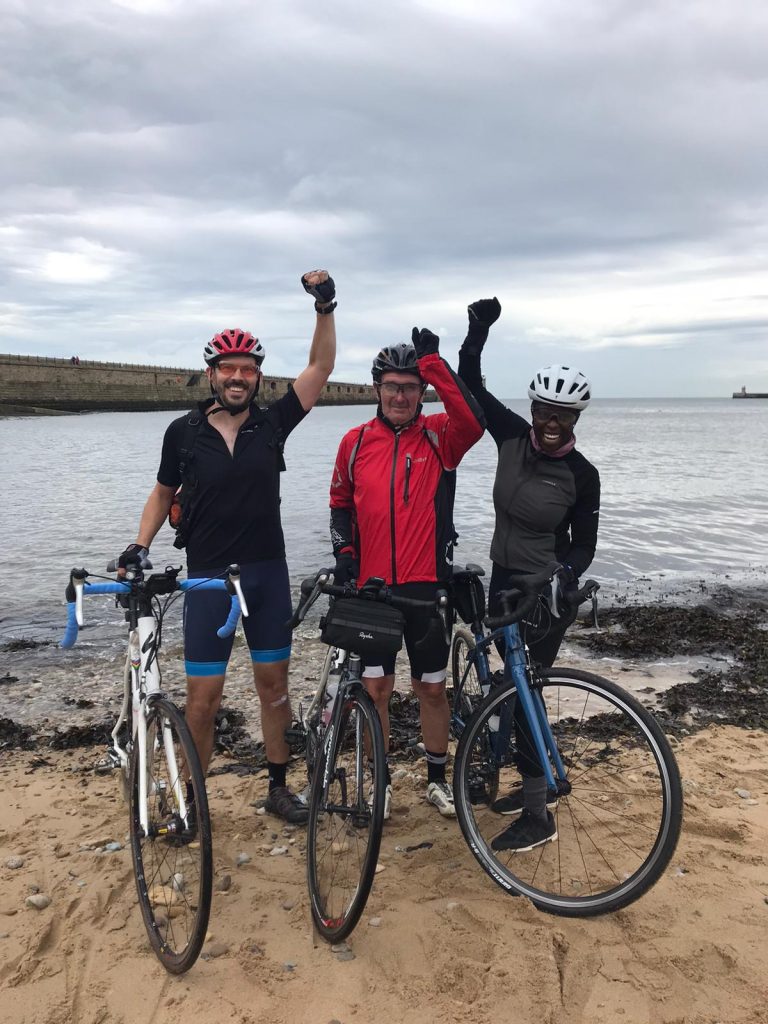
And now I have a new deposit to make in my memory bank of good epic bike rides – the so-called ‘Sea to Sea’ (C2C on the sign posts), which I completed with my son, Jake, and his wife, Amanda, in three days, beginning the day before my 75th birthday on Saturday 10th September.

Choosing to complete this iconic ride in just three stages (4 is preferred by the majority) meant that we each felt very tired at the end of each day of it.

One guide book says that 3  days is a “good choice only for sporty, fit cyclists”. It is right, which is why we each put in the miles beforehand to prepare, especially me, riding at least 140 each week for nearly two months, simulating twice biking over 50 in a single session. I also dieted to lose weight. The ride is advertised as a ‘holiday adventure’ in the biking brochures, suggesting it’s a ‘leisure’ experience. It isn’t.

The 143-mile linear ride took us from Whitehaven on England’s west coast, through the northern Lake District, into the north Pennines, and then onwards through Weardale to the River Tyne and on to Tynemouth.

We were in the saddle for nearly 20 hours, thus averaging 7 mph over the whole route. That doesn’t sound very fast; and it isn’t, bearing in mind I normally complete a 20-mile ride in double that speed. But, then, when I ride the country lanes close to my home I am not climbing uphill so much and for so long.

Over the three days of our C2C ride we climbed nearly 12,230 feet. That’s a big number, which included, in addition to many short bitter climbs, two monster leg-shattering ones, each 4 miles long – Whinlatter Pass, 7 miles west of Keswick in the Lake District, which averages 7%; and Hartside Pass, 12 miles west of Penrith in the Pennines, which averages 6%. They both took some getting up, I don’t mind admitting, particularly Hartside, which is regularly used for pro and amateur bike races. It seemed to go on for ever, reminding me of the Le Tour cols I used to ride up and over in my 50s. I found the last half mile especially hard. On the other hand, I have always been impressed how quickly one recovers from such effort, for within 5 minutes of cresting Hartside Mount, where I rested and took in the super views, I was in sufficient good order to carry on. Biking is like that when you’re fit for it.

Climbing up so many feet in just three days made the C2C more of a challenge than the E2E. The total elevation of that last ride is about 14,000 feet, making it counter-intuitively a less demanding prospect than the much shorter C2C, entirely because its climbs are spread over nearly two weeks rather than a few days. By riding West to East, which is the recommended option, we also experienced steeper climbs than if we’d gone East to West.

The reverse side of climbing of course is descending. In biking, the standard rule is: for every up, there is a down.

Some of the downs we rode were exhilarating, particularly the descent after Allenheads in Northumberland: nearly 6 miles of uninterrupted downhill to Rookhope, on a near-perfect surface, averaging -5%, which is where I achieved my top speed for the ride – 37 mph, Jake peaking at 39.

The worst downhill section was the very steep descent to the bleak Pennine settlement of Nenthead. OK, it was only just over a mile long. But safely navigating a bike down a -20% incline, maxing at -25%, took some doing. The rims on my front wheel were scorching hot at the bottom. No wonder this descent is labelled a ‘Bicycle Accident Spot’. My heart was in my mouth as I jarringly made my way down. Jake and Amanda sensibly got off and pushed.

We experienced some spectacular and contrasting scenery – fell tops, forests, green river valleys, bleak exposed moorland – and rode through some lovely villages and market towns – Kirkland, High Lorton, Threkland, Mungrisdale, Troutbeck, Stanhope – following a cleverly conceived route devised by Sustrans, which mostly avoids main roads in favour of minor byways, country lanes and dedicated cycling tracks. We rode straight through Keswick, however, with barely a backward glance, finding it overcrowded with tourists whose preoccupations seemed to be less about enjoying the great outdoors as shopping and eating out.

And the weather held good, with only a small amount of fog out of Allenheads and a brief shower near Consett. Apart from that, we experienced three fine days.

I was pleased to complete this ride for two reasons apart from the actual biking itself.

The first was the opportunity it gave me to spend a lot of quality time with Jake and Amanda, who were perfect companions, both on and off the bike.

Amanda was the less experienced biker in the party, which meant she had to work extra hard on occasion to complete each day’s ride. She faltered not for a single moment, never complaining when the going got hard. She was totally up for it, in other words. And I suspect, because of this, she got more out of the ride than Jake and me combined.

The second was being able to celebrate my 75th birthday – a milestone in itself – with both of them at the end of Day 2 in the Allenheads Inn.

As I blew out the candles on the cake they had laid on to mark the occasion, I said a silent prayer: “Thank you. Who’d have thought two years ago, when you had a life-threatening heart attack, that you’d be here now, doing this? You’re a most fortunate man.”

PS

There are two published guides to the C2C. I do not recommend the one written by Richard Pearce, The Ultimate C2C Guide (2020). It looks very good on paper with its coloured maps and spiral binding; but its descriptions of the big climbs are thin, even unhelpful; and its survey of the final 20 miles is not easy to follow. Jeremy Evans’s The C2C Cycle Route (2021) is much better, I think. It charts the route using edited extracts from relevant OS maps, which makes cross-referencing easy; its advice is always practical and sensible; and its descriptions of the way forward are uncomplicated. A very good waterproof map of the route based on OS data is produced by Footprint – www.footprintmaps.co.uk

Categories
Uncategorized

Wednesday 29 June 2022

Wednesday 29 June 2022: Here are 9 questions that are currently preoccupying me. Do they concern you as well? Do you have better answers to them than the ones I provide?

1.After Wakefield, is Labour on course to win outright in 2024? I don’t think so. Having canvassed in the town during the bye-election, I found no huge enthusiasm for Starmer’s Labour Party. True, it enjoyed a 12% swing from the Conservatives; but that was on a very low turnout (40%); and the Tories hardly campaigned to hold on to the seat, and many of its supporters didn’t vote. That won’t be the case in 2024.

2.Is Johnson’s premiership doomed? I am certain it isn’t between now and the next GE. He won’t resign because he considers he has a mandate from the majority of his MPs and the electorate to ‘get on with the job’. Indeed, Johnson has convinced himself he has only just got started as PM. I am not even sure I want him to resign, cynically thinking that having him in post between now and 2024 will help the opposition parties to defeat the Tories next time round.

3.Is a form of militant militarism becoming the new ‘normal’? I am beginning to think it is, based on the increased number of existing and retired generals I hear on our media – notably on R4’s Today Programme – talking up vigorously the need to increase significantly defence expenditure when they’re not offering strategic advice about how best to beat back the Russian forces in Ukraine and thwart its further expansion westwards, which they assume will happen if we don’t radically re-arm. Equally, I am astonished how all of them are not subjected to critical questioning by interviewers. I am not a conscientious objector; but I am someone who finds objectionable the assumption that waging war is a sensible way of resolving international disputes. Sometimes it undoubtedly is. But diplomacy always entails fewer fatalities.

4.Exactly what ‘values’ are we defending in our support for Ukraine in its war with Russia? Clearly one value that is being defended is the right of countries to have their borders and sovereignty respected. But to frame our condemnation of Russia’s invasion of Ukraine as a binary clash of rival value systems is surely to absolve ourselves of our own alleged war crimes, committed as recently as this century in Iraq and Afghanistan. It is then to pretend our wars are just and only theirs are evil. And what is so special about those of our values which underpin a mode of economic life which distributes income and wealth so unevenly, leading even to the establishment of a national network of foodbanks? And don’t get me started on our democratic procedures which are often, in practice, very undemocratic.

5.Should Ukraine demonstrate a greater public willingness to agree a peace deal with Russia? I think it should, and with the help of its allies, not least because the world’s attention is already showing signs of fading, and many countries don’t share our negative view of Russia’s actions; and the collateral damage from the conflict, including the very high number of civilian fatalities, needs to be reversed. If and when these negotiations happen, Ukraine I guess has to be armed to the teeth to deter future Russian incursions, an opinion, I recognize, that sits a bit uncomfortably with the point I made earlier about the rise of new forms of militarism. Whatever, it’s surely silly, even irresponsible, bombast to say, as our PM does repeatedly, that the war in Ukraine has to be prosecuted until Russia looses it. That will take a very long time, I am thinking; and it is unlikely, in any event, to happen. Meanwhile, more and more civilian deaths will result.

6.Has the class war ended? I am sure it hasn’t. And I think I know why many on the Right want to persuade us that it has. Social and economic inequality is endlessly reproduced by people who either do well out of it or who are too institutionalised to see what is front of them, and who don’t really care when they do.

7.What’s pushing up inflation? Not public sector worker’s wage demands, I am pretty sure, but rather private sector profits, grounded in making money out of the rest of us who buy its products and services, nearly 90 percent of which over the past few years is accounted for by just 25 companies. After a decade of wage stagnation and a pandemic that pushed millions into poverty, the political Right has some nerve to blame the current cost of living crisis on workers attempting to resist pay cuts and changes to their conditions of employment which they judge will make them worse off.

8.Is China our enemy? It ought not to be, but it is increasingly being constructed as such. Few days pass without a western media source publishing a negative story about China. And the number of books being published, particularly in the USA, that do the same is huge. Currently, the West is adopting a ‘compete, counter and contain’ approach in shaping its foreign policy options. My preference is an ‘engage, but hedge and criticise’ stance. I have written about what this might entail HERE

9.Is Brexit working? It isn’t economically, that’s for sure! And those who argued to the contrary in 2016 need to own this fact more. As for the rest of it, given my long-standing Eurosceptic views, I am less convinced that exiting the EU has caused irreparable damage. I have written about this as well HERE 

Categories
Uncategorized

Monday 27 June 2022

Monday 27 June 2022: Although I assume it is not certain that everything is uncertain, I have never, strictly-speaking, been either a fatalist or a teleologist.

Relatedly, while I believe God has a plan for me, indeed for all of humankind, I don’t think for a second it takes the form of a blueprint. It entails rather a calling to think and act within the framework of a virtue ethic which emphasises the primacy of love.

This means I am at best ambivalent about the role played by luck – defined as some force external to human volition – in the ordering of my life, or anyone else’s come to that.

True, unexpected coincidences are a feature of all our lives; but they surely don’t provide evidence that luck exists as a tangible compulsion or constraint. Aren’t such phenomena what we call ‘chance’?

‘Being lucky’ or ‘being unlucky’, it seems to me, are post-event descriptors. One’s luck therefore neither literally holds nor runs out because it is neither tangible nor substantial.

This evening, my latest chess opponent, before we start our game, will shake my hand and wish me “good luck”. This will undoubtedly be a kindly gesture. But it will be one without any actual substance. A bit like saying  “have a nice day”.

So, the recent death, aged just 33, of a Labour comrade of mine  – Hadleigh Roberts – had nothing to do with him having bad luck. It was a cancer that killed him.

Similarly, surviving a heart attack nearly two years ago, while undoubtedly fortunate, had nothing to do with me being lucky. Rather, it had everything to do with me speedily getting the correct treatments on admission to hospital.

It shouldn’t need saying, but Hadleigh’s death and my recovery also weren’t part of God’s plan for each of us. Neither was ‘written in advance’.

The literal non-existence of luck doesn’t however stop us from imagining it can be fostered. Consider the Test Match cricket commentator and former England captain, Michael Atherton. Reflecting on a sudden change in good fortune experienced by an England bowler in a recent international match, he said: “If you keep doing the basics, then eventually your luck will turn”. I don’t think so, Michael. The good fortune you are describing was a happy coincidence of events. Chance, in other words. What if the bowler – still doing the basics – hadn’t taken another wicket? Would that have been bad luck? Surely not. Rather, it would have been a case of the batters being better and the fielding being blameable. Or a change in the weather or state of the wicket?

Or mull over Logan Mountstuart’s philosophy of life. Who? He’s the anti-hero of William Boyd’s picaresque novel, Any Human Heart, whose summary of life’s meaning, as explained to him by his dying father is: “That’s all our lives amount to in the end: the aggregate of all the good luck and the bad luck you experience. Everything is explained by that simple formula.”

Is it? I am pretty sure it isn’t. Indeed, Logan’s bad life chances, as Boyd describes them, seem to me to have less to do with luck than with him too often making the wrong calls.

Non-fictionally, former PM John Major’s remark today that the 1000s of victims of the contaminated blood scandal in the 70s and 80s were casualties of “incredible bad luck” diverts public attention away from the fact that government at the time made some bad calls too, leading to many unnecessary deaths.

I suppose it’s for this reason that I do not dwell too negatively on my own missed opportunities and errors of judgement, despite regretting them very much, entirely because they have been more than compensated for by the chance of seizing other openings, both personal and professional.

In fact, I am almost embarrassed at how much good fortune I have had, especially with timing – in my career, in my partnering, in my parenting, and in my church going. But, on each occasion, I wasn’t a beneficiary of luck; I was instead someone who acted in ways that brought about a desired result, often with the help of others. Teleology had nothing to do with it.

Attending Mass yesterday, on the Second Sunday After Trinity, caused me to reflect explicitly on this aspect. The Psalm for the service was the sixteenth. It’s one of the Lauds/Prime Psalms, which means in St Benedict’s Psalmody it is sung at or near first light, having a strong tone of grateful thankfulness for the day that is about to begin. It also has an air of confidence about it. Verses 5 and 6 especially struck home: The Lord is my chosen portion and my cup/you hold my lot/The boundary lines have fallen for me in pleasant places/I have a goodly heritage.

I do have a “goodly heritage”, for which I am enormously grateful; and which I try hard never to take for granted.

It is the product of three forces: the supporting love and affection provided by those closest to me, notably Kathryn and Jake and Chloe; the counsel and encouragement of 5 individuals during my career and retirement: Paul King (my favourite grammar school teacher), John Reynolds (my PhD supervisor), Patrick Eavis (my best teaching colleague), Geoff Whitty (my academic boss and mentor at UCL), and Tom Middleton (my most important Christian mentor); and my own efforts to make the most of myself.

Some might say I was lucky my path crossed with that of each of the people, excepting my children, who I have just listed.

I prefer to say I picked them out as individuals from whom I thought I would benefit, and they generously gave me their time and attention, helping to nurture in me that virtue ethic which I mentioned at the start.

It wasn’t then chance that brought us together. It was circumstance that I helped, with them, to create.

Categories
Uncategorized

Sunday 12 June 2022

Sunday 12 June 2022: Today is Trinity Sunday, one of the most important Feast Days in the Anglican and Catholic liturgical year.

This feast day, as its name indicates, celebrates the Christian doctrine of the Trinity, the three Persons of God: the Father, the Son, and the Holy Spirit.

The New Testament contains no explicit trinitarian doctrine, which means that many Believers struggle to make sense of it.

It was first formulated among the early Fathers of the Church as they attempted to understand the relationship between Jesus and God in their scriptural documents and prior traditions.

For Unbelievers, it’s a doctrine that seems incomprehensible; for Believers like me it is a Mystery – an example of what I have elsewhere described as an attempt to “word the unwordable” (see HERE). It simply isn’t possible to find words adequate sensibly to communicate the idea that God is One, but is experienced as three ‘persons’.

I guess this is why many priests resist giving sermons on the doctrine on Trinity Sunday; and, if they do, often get themselves into all sorts of knots trying.

Mind you, I still recall happily from my youth one such brave effort, resulting in the priest saying something like this: The Trinity is like three musicians playing a trio sonata. Although they play on different instruments, the musical piece created is a wholeness.

More recently, I have found helpful the words of my favourite theologian, Rowan Williams, on the topic, though you surely must first be members of the Faithful to begin to grasp their relevance. Unbelievers, I suspect, must find them unfathomable:

We call him the Son of God. But we do not mean by this that God has physically begotten him, or that he is made to be another God alongside the one God. We say rather that the one God is first the source of everything, the life from which everything flows out. Then we say that the one God is also in that flowing out. The life that comes from him is not something different from him. It reflects all that he is. It shows his glory and beauty and communicates them. …… And we say that the one God, who is both source and outward-flowing life, who is both ‘Father’ and ‘Son’, is also active as the power that draws everything back to God, leading and guiding human beings towards the wisdom and goodness of God. This is the power we call ‘Holy Spirit’. So, when we speak of ‘the Father, the Son and the Holy Spirit’, we do not at all mean to say that there are three gods – as if there were three divine people in heaven, like three human people in a room. Certainly, we believe that the three ways in which God eternally exists and acts are distinct – but not in the way that things in the world or even persons in the world are distinct.

Well, there you have it; or you don’t.

Interesting for me is some associated reading I have been doing lately which has relevance to the church’s trinitarian doctrine – Dante Alighieri’s Commedia. The number three, I have discovered, is so much an informing principle of his poem, with trinitarian allusions cropping up everywhere in it, despite Dante’s protestation that the Trinity is ultimately beyond human comprehension. Believers, he says, are therefore required to take it on trust: Mad is he who hopes that our reason can go down the infinite path taken by one substance in three persons. Be content, human kind, with what is (Purgatorio, 3, 34-7).

Elsewhere, Dante spells out his understanding of the doctrine: and I believe in three eternal persons, and I believe them to be one essence, an essence so one and so threefold that it takes ‘are’ and ‘is’ simultaneously (Paradiso, 24, 139-41).

I am rather impressed by Dante’s cleverness here. Saying that in the Trinity the verb to be is used in the plural and the singular at the same time is a smart move, successfully marrying the intellectual and mystical aspects of faith. It also coincides with what is found in the New Testament, as Dante testifies: With this deep mystery divine I’m broaching now, the gospels stamp my mind at many points (Paradiso, 24, 142-44).

I guess it must have also rung true to Dante as he uttered these words in his imagination at the very point at which he ascended into Paradise.

Friday 18 March 2022: Two weeks ago, I met a forgotten friend, Barbara Hepworth, in Wakefield, at an art gallery named after her.

The occasion was seeing a show of her work – Barbara Hepworth: Art & Life – which the gallery’s artistic director and Hepworth specialist, Eleanor Clayton, had curated.

All the gallery’s exhibition spaces were given over to an extensive display of Hepworth’s sculptures: early figurative marble and wood carvings and later textured bronzes and steel constructions, both small and large. On show as well were some of the artist’s geometric sketches and a selection of her less well-known hospital drawings of the late 40s.

While these exhibits only scratched the surface of Hepworth’s huge output, it was more than enough to remind me of why I was so taken up with her work when I first encountered it in my early 20s, coinciding with my first excited acquaintance with the stone abstract carvings of her contemporary, Henry Moore. But why hadn’t I bothered with it much since?

For sure, a few years ago, during a cycling holiday in Cornwall, I briefly visited Hepworth’s last home, now the Trewyn Museum Studio near St Ives, where I walked around its garden-strewn display of standing works; and previously I’d been to the Yorkshire Sculpture Park to see her multi-part bronze The Family of Man, completed shortly before her death in 1975. But, other than that, I only rarely consulted Hepworth’s work in my mental catalogue of visual art images.

Moore suffered from similar inattention, making me wonder why I’d mindlessly turned away from his and Hepworth’s abstract sculpture in my middle and later years.

Given my religious and utopian sensibilities, it ought not to have, because Hepworth’s vision in particular overlaps significantly with them.

Her creative philosophy, akin to aspects of my own much minor one, was unfailingly about seeking new ways better to express the experience of the spiritual within the physical, which meant that each sculpture she produced motivated in her the desire immediately to create an improved representation of the same image in her next effort: “There is always some falling short of the image, some imperfection; but one is carried forward to the next creative act by the force of the idea one is trying to express.”

Whatever, I was bowled over by Eleanor Clayton’s show, getting prepared to see it by buying and reading in advance her newly published and well-reviewed biography of Hepworth (CLICK HERE for details). I also caught up with Alan Yentob’s equally impressive Imagine profile of the artist first broadcast by the BBC two years ago.

A huge shock of positive recognition gripped me as I walked round Clayton’s show.

Each of the sculptural forms that impressed me on my first encounter with Hepworth in the late 60s, and that always had a special meaning for her, were on display: “the standing form (which is the translation of my feeling towards the human being standing in landscape); the two or three forms (which is the tender relationship of one living being beside and with another); and the closed form, such as the oval, spherical or pierced form, sometimes incorporating colour (which translates for me the association of meaning of gesture, either in nature or in the human spirit.)”

 A fine example in Clayton’s show of the last of these forms was Configuration (Phira), which Hepworth carved in 1955. This hardwood sculpture reminded me of how much Hepworth enjoyed the process of creating a symbiosis between material and finished form: “the intense pleasure for me is in relating oneself to the ‘life’ in the particular material.”

Its hemi-spherical shape faithfully follows the grain of the wood; while a hole carved into it invites one to look through the object and beyond it, constituting a material metaphor.

It’s also a poignantly optimistic piece. For the occasion of its carving was the premature death of Hepworth’s eldest son, Paul, news of which inaugurated an extended period of depressive grief for the artist.

Phira therapeutically recalls a cradle and a beating heart, while its polished hardwood gives off a warm memorial glow.

I am pleased to know I can continue easily to view Phira because Clayton borrowed it for her show from the City of Leeds Art Gallery where normally it is on permanent display.

Meanwhile, Hepworth’s earlier Three Forms (1939) reflects the relationships between the three babies she had given birth to in 1934, including her maternal loving bond to each of them.

Clayton’s description can’t be improved upon: “Three white marble rounded forms of varying sizes and character are place asymmetrically on a rectangular base of the same material. The base functions as the mother of the group, providing support, unbreakably connected by common physicality.”

Among the many examples of Hepworth’s standing forms on show in Wakefield, one particularly caught my eye – Two Forms with White (1963).

Like Phira, this is a hardwood carving; but, unlike the latter, it stresses the power of the vertical rather than the spherical in the landscape.

Clayton: “The two forms stand upright, Hepworth using the grain of the wood to emphasise their verticality, while incorporating the concavities of the landscape in their scooped, white-painted fronts.”

Holes link both works. In each piece we are encouraged imaginatively to look through and create something new on the other side, or simply to lean in and hope for the best – a piercing aperture, in other words.

As Hepworth said: “so much depends in sculpture on what one wants to see through a hole!”

Elsewhere, she writes: “I am most often aware of those human values which dominate the living structure and meaning of abstract forms. Sculpture is the fusion of these two attitudes. The dominant feeling is always the love of humanity and nature.”

Tuesday 1 March 2022: Earlier today, NATO’s chief, Jens Stoltenberg, called on Russia to end the war in Ukraine and withdraw all its forces, adding that the alliance would not send troops or combat jets to support Kyiv as it does not want to become part of the conflict.

The chances of the former happening sadly are non-existent; the news that the latter won’t be, on the other hand, is reassuring.

For while I am aghast at what Russia’s military is doing in Ukraine, the last thing I want is for the conflict to involve other countries. That could trigger a third world war, implicating nations that possess huge arsenals of nuclear weapons, one of which, Russia, has frighteningly already indicated a readiness offensively to use them.

Such considerations weren’t too evident in the comments made during a pair of interviews conducted last night by Mark Urban, the BBC’s Diplomatic Editor, while anchoring a Ukraine War special edition of Newsnight.

A much-published student of military history, Urban seemed taken-aback by the comments made about the progress of the war by his two studio guests – Inna Draganchuck, a Ukrainian Deputy Minister, and Britain’s General Sir Richard Barrons, former Commander of Joint Forces Command, as each talked up the possibility of NATO involvement in the event of heavy Russian artillery bombardment of Ukraine’s major cities.

Sir Richard spoke about “the application of NATO’s military power”; while Draganchuck willed the introduction of a NATO-enforced ‘no fly zone’ over her country.

“But that would mean war with Russia?”, a surprised Urban replied. Neither of his studio guests appeared to notice this rhetorical query. Nor did former Foreign Secretary, Jeremy Hunt, interviewed separately later. “Putin is a man that only understands strength”, he sombrely declaimed.

I don’t mind admitting I found it hard to go to sleep after hearing all of that.

Jens Stoltenberg’s assessment surely must prevail, I thought on first waking up this morning; and maybe too, I imagined, Ukraine’s president, Volodymyr Zelenskiy,  needs to be encouraged to identify a way of speech-making that encourages finding ways to stop the war and not just effectively to prosecute it.

This is a war his country cannot win, which means he surely should be trying to find an off-ramp from the conflict to lessen the loss of life, on both sides.

I am told by some that this last sentiment is a betrayal of Ukraine’s just cause – that I am an appeaser of sorts. Really?

In the absence of direct military aid, it is surely madness to think Ukraine can successful beat back and put to flight a Russian military force that is massively superior to its own, both numerically and technologically.

Undoubtedly, its smaller army and airforce can frustrate Russia’s advance and delay Putin’s cynical victory.

But the loss of civilian lives this will inevitably entail cannot be glossed over. ‘Ought implies can’, don’t my armchair militarist critics know?

And as for me being an appeaser. Give me a break. The British Establishment, for over two decades, while trumpeting and seeking to export ‘western values’, has willingly cosied up to the Russian kleptocrats and, crucially, their money.

All of this is graphically exposed in Catherine Belton’s meticulously researched anatomy of the Putin regime – Putin’s People: How the KGB Took Back Russia and Then Took on the West, which convincingly shows how western governments that like to preach the rule of law and the benefits of free markets have turned a blind eye to the plunder of Russian businesses by the Kremlin and its allies.

Belton’s book outlines how western companies rushed to sign new deals that legitimised the proceeds of these corporate raids, while our banks laundered the Kremlin’s dirty money, allowing it to penetrate the economies of Europe and the US.

What Belton says about the Blair years matches the conduct of each of the governments that followed his: “Tony Blair’s government seemed to have given the order for London to throw open its doors to Russian money, regardless of its provenance.”

The British political and professional class has then shown itself to be especially greedy where Russian money is concerned. It has appeased Putin’s malign activities for years, with many of its elites happily throwing in their lot with him (about this, see this recently published article in Foreign Affairs:

https://foreignpolicy.com/2022/02/15/gerhard-schroder-gazprom-russia-tony-blair/).

This doesn’t render misdirected their anger about the conflict Russia has initiated.

But it does cause this sceptic to query their immediate reaction to it, cynically wondering in particular if they will comprehensively make Johnson’s sanctions stick.

After all, they didn’t after 2014, following Putin’s earlier military incursion into Ukraine.

As former Tory Attorney General, Dominic Grieve, writing in the Sunday Observer last weekend, said: “our efforts to root out the corruption and sanction those with links to Putin [since then] have been woefully inadequate.”

I am equally nervous about the West’s ability to help broker and maintain a decent peace once the shooting stops.

While Putin will have to play a role in this process, there is no evidence currently available to suggest he can be trusted, which may mean the West has to bide its time before making hard plans, pending him voluntarily leaving office or being forced to stand down. Some pundits speculate this may be within two years. The West needs to bear this likelihood in mind before rushing to bolster their defence budgets, which Germany is already committed to.

Which leads me to ask if the West can be relied upon to express sufficient understanding, even clemency, in building a new peace, given its arguably insensitive approach to the expansion of NATO following the dissolution of the USSR during the period 1998-91, which Putin has described as provocative and threatening. I am concerned that the West will repeat this error of emphasis, particularly if it shortly fast tracks the applications to join NATO of other nations close  to Russia’s borders.

One doesn’t have to be a Putin apologist to appreciate this point, as David Allen’s letter published in the Guardian the other day explains: “Putin is Russia’s disastrous response to the triumphal advance of NATO and the EU across the old Soviet fiefdoms of eastern Europe. Nelson Mandela, uniquely, understood that it is crucial for victors to be magnanimous, to offer friendship to those they defeated, and thus seek to avoid renewed conflict. We have not learned from him. Putin is a monster. But we, the West, were the midwives at his birth.”

This doesn’t justify Putin militarily invading a neighbouring country, let me be clear.

Rather, it provides important context and background, whose nature needs to be recognised by NATO’s architects in the next phase of their thinking.

Absurd though it is to imagine, they might for example contemplate the outrage that would arise if the PRC built an impressive military alliance implicating Canada and Mexico. Beijing’s argument that such an alliance, like NATO’s, merely serves a defensive purpose would rightly not be found compelling.

These are not irresponsible, wildly Leftist, Stop the War, thoughts of mine, as a few of my critics have irritatingly described them.

On the contrary, they are one side of a complex debate which needs open-mindedly to be entered into rather than peremptorily brushed aside (see, for example, Professor John’s Mearsheimer’s Foreign Affairs article ‘Why the Ukraine Crisis [of 2014] is the West’s Fault’, which he speaks about in this YouTube lecture: https://www.youtube.com/watch?v=JrMiSQAGOS4).

If the West has made mistakes, and Mearsheimer thinks it has, it needs, I am saying, to make sure it does not repeat them.

What worries me at the moment is that the West’s reaction to the conflict is excessively revengeful and insufficiently cultural. That’s understandable; but it’s not a basis for stopping future wars.

Also, if our values are truly under threat, as many of the hawks and retired generals say, it would help if we practiced them a bit more consistently.

One of the Russian bankers interviewed by Belton wasn’t joking when he remarked that “it turned out everything depended on money, and all those values were pure hypocrisy”.

My critics then have rightly challenged me to spell out what I think Britain’s immediate response to Russia’s invasion of Ukraine should be.

My list of actions includes some don’ts as well as dos:

(1) Take care not to close off too many avenues of diplomatic exchange, although efforts arguably should be made immediately to suspend Russia from being a permanent member of the UN Security Council. Isolating Russia is no bad thing; totally excluding it is.

(2) Convene talks with the leaders of China, India and UAE with the aim of using each as a broker in negotiating a peace deal. China has already declared a willingness to mediate. Britain should encourage it immediately to act upon this good intention.

(3) Tone down the warrior rhetoric. Prioritise instead discourses that emphasise bringing the war to an end rather than encouraging it to continue. Do not then offer verbal sustenance to private citizens who want to join the fighting. Instead, assertively deter such behaviour.

(4) Make clear that Britain would not support any military involvement on the part of NATO, including enforcing a ‘no fly zone’ over Ukraine, which President Zelenskiy this afternoon requested. If agreed to, the results of such an action would be uncalculatable and potentially very dangerous for world peace. Zelenskiy should be told bluntly that his request won’t be acceded to and that he should stop making it, for it is irresponsible. He should be cautioned too that the inclusion of Ukraine in NATO after hostilities have ceased may not be in the interests of world peace. Similarly, promptly admitting his country to the EU might also not be a wise move.

(5) Stop sending weapons to help prolong the conflict, particularly in the absence of trainers to teach volunteer territorial defence units how to use them. To do otherwise is also irresponsible.

(6) Totally remove Putin’s influence domestically, financially, and politically from Britain, including all sporting and cultural ties. In particular, immediately freeze all Russian assets held here; cut out commercial contact and dependency on Russians; and require any Russian citizen whose presence is not judged to be conducive to our public interest to leave.

(7) Put in place a comprehensive programme to provide sanctuary to all those displaced by the conflict who choose to come to the UK to escape from it.

(8) Identify a huge sum of public money to aid Ukraine’s efforts to meet the immediate and on-going medical and general humanitarian costs of the conflict.

(9) Prepare now for post-conflict discussions. And don’t just assume these should centre on enlarging the West’s  defence budgets. Deterrence is not the only way to maintain peace. Mutual respect of differences and understanding of their implications should feature as well.

Categories
Uncategorized

Thursday 27 January 2022

Thursday 27 January 2022: Next Wednesday is an important anniversary for all those, like me, that have a very high regard for James Joyce’s epic, encyclopaedical, satirical, and hard to read work, Ulysses, which Anthony Burgess once evaluated as the greatest novel of the 20th century.

For 2nd February 2022 is the 100th birthday of its publication as a complete book, in Paris, coinciding with the author’s fortieth birthday.

Its first appearance also roughly tallies with the emergence of Ireland as an independent free state, which formally came into being a few weeks earlier.

Thus, it appears, the first great modernist novel was published at near the same time as the advent of the first modern European state.

The redemptive glimpses that Ulysses offers of a better of way of living is maybe Joyce’s way of anticipating a utopian future for his homeland.

Of course, while this is most likely accidental, it may not be incidental, not least because Ulysses is written by an Irishman – albeit a self-exiled one – who cleverly, and in exacting detail, over many pages of verbal inventiveness, recreates some of the streetscapes, institutions and unusual characters of Ireland’s colonial capital, Dublin, on a single day at the turn of the 19th century – 16th June 1904.

Accompanied by Leopold Bloom and Stephen Dedalus, Joyce takes us on a walking ambit of the city centre, which is helpfully recreated in the form of 8 ‘tours’ in Robert Nicholson’s The Ulysses Guide.

Some of the photographs accompanying this post show me following the various routes he recommends. I wonder if you can work out where I am, and which episodes they apply to. 

BBC Radio 3, I notice, is acknowledging the occasion of the first appearance of Ulysses with a series of five short broadcasts in its Essay slot, beginning on Monday 31 January, while Radio 4 is dedicating Archive on 4 this Saturday to the novel. Nothing on TV, as far as I can tell.

I haven’t decided how I will recognize the anniversary, other than to listen to those programmes, though it’s likely I will do what I always do on ‘Bloomsday’, which is to read an episode from the novel, choosing one that reflects especially well on its central character, Leopold Bloom, Joyce’s masterwork of characterization, who I was so pleased to meet when I first properly read Ulysses, aged 41, in 1988.

The nature of that experience, plus a subsequent one like it, is written about HERE

Both were a huge test of patience and concentration, entailing fathoming out a host of unusual historical and literary allusions, plus getting to grips with scores of puns, jokes and foreign phrases. Thank goodness for Don Gifford’s Ulysses Annotated, is all I can say.

In that earlier appreciation, I quote Joyce’s greatest biographer Richard Ellman’s generous estimate of Bloom: a humble vessel elected to bear and transmit unimpeached the best qualities of the mind.

More recently, the comedian and writer, David Baddiel, in a conversation with Irish Times arts and culture editor Hugh Linehan about his new book, Jews Don’t Count, says much the same, but more, reminding us that Bloom is Jewish. In the novel, he is subjected to regular anti-Semitic prejudice, which he subtly and repeatedly challenges, particularly in the extra-long Cyclops episode: It’s incredible how right Leopold Bloom is [says Baddiel]. In my experience, non-Jews writing about Jews, they just don’t get it right most of the time. To some extent, they just foreground the Jewishness too much. The one time that doesn’t happen is [with Joyce’s] Leopold Bloom. And I literally can’t fault him, in the way he is, the way he thinks. He’s Everyman, yet there is something really Jewish about him, there’s an evanescent quality about him that Joyce absolutely gets.

When, in The Cyclops (Episode 12), Bloom is confronted by the ‘one-eyed’ citizen, a virulent anti-Semitic Irish nationalist, he patiently makes the case for an open, tolerant Irish nationalism – A nation? asks Bloom. A nation is the same people living in the same place (p.430).

And, when rebuffed and threatened subsequently, Bloom reasonably fights back, saying, Mendelssohn was a Jew, and Karl Marx and Mercadante and Spinoza. And the Saviour was a Jew and his father was a Jew. Your God ….Your God was a Jew. Christ was a Jew like me (pp. 444-5).

I have written myself into reading The Cyclops episode next Wednesday, don’t you think?

And maybe also the short chapter about it in Daniel Mulhall’s newly published book Ulysses: A Reader’s Odyssey, in which he writes: Cyclops is crucial in identifying Bloom as an apostle of tolerance and moderation in a world trending towards extremes. To that extent, Bloom challenges the populist mood of our current times.

In his fine book, Ulysses and Us: The Art of Everyday Living, Declan Kiberd is also truly spot on when he writes: here [in this episode] Bloom knows and feels a lot more than anyone else . . . he is the more dignified protagonist . . . his role is not to teach any great truth in words, but simply to embody a better way of being in the world.

I have written as much myself, reflecting similarly on the experience of first meeting Bloom: I became totally absorbed. I began to think Bloom-like thoughts, wishing I was more like him – to love without being possessive; to be generous without being prompted; to be magnanimous without being sycophantic; to be sincere without being bigoted; to be strong without being assertive; to be simultaneously cosmopolitan and supremely local; and to be practically minded as well as intellectually driven.

It’s easy then to appreciate and admire Bloom, whose credo from Cyclops I like to quote:

But it’s no use, says he. Force, hatred, history, all that. That’s not life for men and women, insult and hatred. And everybody knows that it’s the very opposite of that that is really life.

What? says Alf.

Love, says Bloom. I mean the opposite of hatred (p.432).

Bloom’s credo here is spoken. But so much of what we know about him is based on his recorded thoughts – those internal monologues that are such a feature of the novel which caution us to reflect on the relationship between our inner and outer lives: where does one begin and the other end? Are they all of a piece? In Ulysses, it’s not clear. But, then, in practice, it often isn’t.

The Irish novelist, Anne Enright, correctly sums up the implications: More than any other book, Ulysses is about what happens in the readers’s head. The style obliges us to choose a meaning, it is designed to make us feel uncertain. This makes it a profoundly democratic work. Ulysses is a living, shifting, deeply humane text that is also very funny, It makes the world bigger.

It is also sometimes said that Ulysses is a novel in which a key theme is the coming into being of the book itself. This is effectively what Stephen Dedalus is tasked with: to write UlyssesI want you to write something”, Myles Crawford, the editor of the Freeman’s newspaper says to him. “You can do it . . . Put us all into it, damn its soul  (p.171).

In my case, Ulysses is more of a book which brought me into being as a new kind of reader, particularly of fiction. As Joyce’s most recent biographer, Gordon Bowker, says, Stephen’s philosophical meanderings, Bloom’s day-dreaming, and Molly’s nocturnal reveries, demand a new kind of reading, and a new kind of readership

Bowker here is leaning on Ellman’s earlier observation that Joyce requires that we adapt ourselves in form as well as in content to his new point of view, which is to do with privileging the commonplace, using a rich mix of contrasting prose styles that mimic its interior and exterior dynamics.

And it introduced me to some very amusing quotes, of which this one is my all-time favourite:

I am exhausted, abandoned, no more young. I stand, so to speak, with an un-posted letter bearing the extra regulation fee before the too late box of the general post office of human life (p.642).

Only Joyce could have written that, don’t you agree?

Saturday 15 January 2022: Adam Phillips, my favourite Freudian, has an interesting essay in the current edition of LRB (6 January 2022).

Its theme is ‘opting out’, in which Phillips challenges his readers to consider whether there are any pleasures in giving up rather than carrying on: “The question I want to broach is not why do we give up, but why don’t we? What are we doing to ourselves and others, sometimes, by not giving up?”

Phillips, unsurprisingly, draws Freud’s ‘death instinct’ into his queries – “the part of the self that wants to give up, to give up on perpetually attempting and achieving a renewal of life” which he connects with “a continual debate going on inside us . . . . about whether we really believe that life is worth living, whether life is worth the trouble”.

He writes what I often think – that “it is shocking what people will put up with; it is astounding how few people kill themselves.”

The restorative effects of sleep are also worth considering, Phillips says: “every night we give up: give up consciousness, give up thinking, give up vigilance, give up alertness . . . give up on a waking life.” To that extent, sleep “is [maybe] the clue to an ample sense of the value sometimes of giving up”.

But that is not how we normally think of sleep, is it? Nor does the idea that life is worth living present itself to us as a belief. Rather, as Phillips correctly says, “we are more likely just to go on living as if it is true”.

When we start to doubt its truth, we are thus asking ourselves: what is worth surviving for? And even: what is worth not surviving for?

Me? In the last case, I would consider my life not worth living when it becomes pointless through gross physical and mental disability or ferociously distracting pain, making me an inevitable nuisance not just to myself but to others. That’s the kind of life I’d want to give up, as my living will explains.

What’s worth surviving for, providing I am compos mentis, on the other hand, needs thought.

Freud’s answer is ‘pleasure’; Marx’s ‘social justice’.

Together, do they touch all my bases? Broadly defined, I think they might, providing I am able still to enjoy the former and help to promote the latter.

Friday 14 January 2022: At the start of City of Books, a chapter I wrote in 2017 about the holding power of serious literature (read it HERE), I approvingly quote the English author Geoff Dyer: “certain books are held dear because they are psychic landmarks revealing where and how they helped us come into a better consciousness”. The critic Edward Said has written similarly: “I pick up a book . . . What I find inspires me, or moves me, animates me, gets me excited intellectually.”

This post identifies and comments on three books I first read many years ago that significantly helped me then to come into a better consciousness, and which move and animate me still in my old age.

These books, each of which is short in words, but profound in substance, are classics; and they are related. The first two envisage a better society; the third a more human way of living socially in a small community.

Marx and Engels’ The Communist Manifesto, first published in 1888, initially came into my life during the fortnight before I left grammar school in 1966, when, aged 18, I read it as one of several titles recommended as important by my then general studies teacher.

I recall reading my own newly purchased copy in a single afternoon, underlining numerous passages on its pages whose meanings I thought coincided with the socialist ideals I was beginning at that time to ferment in my imagination.

I still have that copy. And I still approve of the highlights I made in it fifty-six years ago.

At one point in the Manifesto, Marx and Engels identify a set of “necessary measures” designed to usurp the “old social order”.

These include: the “abolition of property in land and application of all rents of land to public purposes”; the introduction of “a heavy progressive or graduated income tax”; the “centralization of credit in the hands of the state by means of a national bank with state capital and an exclusive monopoly”; the “bringing into cultivation of wastelands, and the improvement of the soil generally in accordance with a common plan”; the “gradual abolition of the distinction between town and country by a more equable distribution of the population”; and the provision of “free education for all children in public schools”.

I subscribed then to each of these measures; I still do. I also persist in thinking Marx’s analysis of the alienating and inequitable effects of unchecked capitalist growth is fundamentally true, which is why other passages in the Manifesto continue to inspire and tutor my political judgement:

“The ruling ideas of each age have ever been the ideas of its ruling class”; “we shall have an association in which the free development of each is the condition for the free development of all”; “Communism deprives no man of the power to appropriate the products of society; all that it does is to deprive him of the power to subjugate the labour of others by means of such appropriation”; “The distinguishing feature of communism is not the abolition of property generally, but the abolition in particular of private bourgeois property . . . which capitalists use to exploit wage labour”; “The written history of all hitherto existing society is the history of class struggle”.

I was a Christian socialist before encountering the Manifesto. After reading it, I became a Marxist socialist. I continue to be.
Next up is Thomas More’s Utopia, the first edition of which came out in 1516. The version I own is dated 1965. I first read it in 1986, aged 38.

While there is no evidence to indicate that either Marx or Engels knew of, least of all read, More’s blueprint of the perfect republic, we do know each was impressed by similar visions, though cautious about interpreting them as providing enough impetus for bringing about the sort of social transformation they regarded as a human necessity. Only revolutionary struggle, they both insisted, could achieve that. Good ideas were a necessary condition for radical change; but they could never be sufficient for it.

My initial encounter with More’s little book was provoked by taking part in a bruising debate about the future of comprehensive education held in Oxford in the summer of 1986, to which I made a significant contribution, advocating strongly progressive views which many in the room – mostly headteachers – found objectionable, provoking one of them to say, “you’re nothing but a utopian, a builder of castles in the sky”.

This was meant as an accusing insult, and I took it as such, consequently angrily over-reacting, neglecting to say that my utopianism had a distinguished literary and philosophical pedigree, which More instigated, and from which we can learn a thing or two. I didn’t because I was ignorant of it.

But I did read Utopia soon after to learn what I should have said, and I also drew on it and other relevant literatures subsequently to write Hope and Education, a book about the relevance of the utopian imagination for discussions of educational policy, which was published 17 years later in 2003.

More’s Utopia I learnt in 1986 does not consistently advocate progressive ideals. More is comfortable with slavery, for example.

His utopian ‘method’, on the other hand, which holds up a mocking fantastical mirror exposing the distortions of real-life societies, is cleverly insightful. Reading about it for the first time reminded me of the important role visions should play in practical politics.

It confirmed in my mind the view that ‘being politically realistic’ is an empty slogan in the absence of them. What works is not always what’s best. What’s best should be based on ideals and not just on what is considered feasible.

More’s vision then caused me to be more confident in expressing myself about the form and character of a better society – a socialist society – drawing me into an imaginary perfected world that helped me to think critically about the one I ordinarily exist in and help to recreate.

It inspired and animated my political consciousness, in other words, which means that, to this day, conducting utopian thought experiments continue to be part of my make-up as a political activist. More’s Utopia kick-started this habit.

Meanwhile, Saint Benedict’s Rule, composed in Latin in about 540, which I first came across in my early 30s at a religious retreat in Dorset, and about which I have written elsewhere on this website (see below at ‘Worth Abbey’ and my Church Page), gave me my first significant insights into what might make a balanced and fulfilled personal existence, showing me in particular how the ordinary and the humdrum could become the opportunity to find the presence of God in my own daily life.

I am not saying for a second that I have ever fully responded to the Rule’s call. On the contrary, all manner of factors has sadly got in the way of me achieving that; and its requirements – especially as set down in Chapter 7, which is about the importance of humility and how to achieve it – are deeply challenging, particularly for someone like myself who has often been suspicious of its status as a virtue.

Even so, the journey prescribed by Benedict offered me a directional map which I still take very seriously, though I regularly wish I had attended to his guidance more closely in my middle years, which I am convinced would have been lived better than they were if I had.

Categories
Uncategorized

Monday 20 December 2021

Monday 20 December 2021: Sad to report, but it is looking very unlikely, given the rapid spread of omicron, I will be flying to NYC early in the New Year, which among other things means I won’t see face-face, Renée, my granddaughter, now nearly 7 months old. This photograph of her, taken a few days ago, gives a good idea of what I will miss:

My Quote of the Day: “Getting started, keeping going, getting started again – in art and in life, it seems to me this is the essential rhythm not only of achievement but of survival, the ground of convinced action, the basis of self-esteem and the guarantee of credibility in your lives, credibility to yourself as well as others.” – Seamus Heaney, Graduation Ceremony, University of North Carolina, May 12, 1996.

Between Monday 13 and Thursday 16 December 2021 I attended a mostly silent and largely solitary retreat at Worth Abbey in West Sussex, a community of Roman Catholic monks who follow the Rule of St Benedict.

It felt on arrival a familiar place, probably because Worth Abbey featured centre-stage in the BBC2 documentary series The Monastery first broadcast in August 2004, which I enjoyed viewing at the time. (It’s still available on YouTube.)

The TV retreatants set out to discover whether the Christian monastic tradition offered insights and values that could accompany them through life in the secular world. Despite initial scepticism on their part about that, several discovered this to be the case.

Me? I didn’t go to Worth Abbey for that purpose, for I have never doubted the value of the religious, Christian-specific, life, either full-time within or part-time without a monastery.

My doubts have always centred instead on my ability, or lack of it, to do adequate justice to my faith – to respond well enough to its call in terms of how I live my life and undertake worship and related devotions.

I have allowed other things to get in the way of adequately living religiously, particularly career, political activism and hobbies; and I have made up excuses, notably intellectual ones, for neglecting the process.

And, like many critics of the Church, I have used its institutional weaknesses, which are undoubtedly numerous, to justify keeping it totally at arm’s length, forgetting that all of the bodies I have otherwise mostly happily associated with, and to which I have regularly given the benefit of the doubt, have their faults too. Don’t get me started on the Labour Party, for example. Or the English school and university sectors.

True, none of these organisations, unlike the Church, has self-consciously tortured or sexually harmed anyone. But, just as Stalin’s Gulags do not define communism, nor does the Spanish Inquisition sum up Christianity. 

My purpose in retreating to Worth was not then to reboot my faith, which has been largely intact since I first embraced a form of it in my early teens, but to refresh it – specifically, to give my reaction to its demands a new lease of life; and to learn better ways of responding in worship, prayer and reading to its devotional requirements.

It’s also fair to say that my retreat was, to quote one of the abbey’s monks, “a good way of getting away from the money-making version of Christmas”.

At Worth I fell in immediately and totally with its Liturgy of the Hours, which meant I spent a lot of time in the Abbey Church, taking part enthusiastically in each of its daily – Psalm-based –  offices (Matins, Lauds, Midday, Vespers and Compline), with Mass in the afternoon and Lectio Divina in the morning.

After two days of this, I felt very much ‘at home’, which is a notion I meditate on a lot in my normal devotions – “He keeps me safe in his shelter” (Psalm, 27,5).

Feeling ‘at home’, of course, is what Benedictine monks strive hard to create in their houses – what they define as ‘stability’.

Following St Benedict’s Rule helps them to achieve it.

If you’re interested to know more about this, see what I’ve written about it on the Church page of this website.

Just scroll down until you reach the section about The Way of St Benedict (it’s after the one on John Henry Newman).

Designed to encourage sound interpersonal and institutional habits – what Rowan Williams calls a “prosaic settledness” – Benedict’s Rule helps to create “heaven in and through the ordinary” (George Herbert).

I also learnt at Worth some new ways of approaching Lectio Divina, a prayerful resource which I have rarely made the most effective use of, entirely because I find it hard to read Scripture without ‘studying’ it. 

Fr Martin referred me to something a favourite theologian of mine, Dietrich Bonhoeffer, once wrote about how to read Scripture more openly, without prejudice: “We ponder the text on the strength of the promise that it has something utterly personal to say to us for this day.”

Fr Martin also gave me some very helpful advice about my personal prayer life in general, which I often think is very inadequate, because it lacks sufficient structure and content: “Pray as you can, not as you can’t”.

Lectio Divina caused me to re-read a favourite verse in St Paul’s Letter to the Romans:  “When God speaks, his word calls into existence things that do not exist” (Chapter 4,17).

My recently written essay, ‘On Wording the Unwordable’, I have decided, is a long footnote to this verse. It can be read HERE

On Tuesday I joined in the monks’ celebration of the ministry and poetry of St John of the Cross, recalling this famous line from (I think) his Spiritual Canticle – “Seek in reading and you will find in meditation; knock in prayer and it will be opened to you in contemplation.” Very relevant to Lectio Divina, I concluded.

And I learnt more about St Lucy. whose martyrdom was recalled the day before, about whom previously I had known next to nothing, excepting she plays an important role in Dante’s Comedy, in which we are told, among other things, she carries a sleeping Dante to the entrance to purgatory, bearing a light to illuminate the way. Dante’s allusion is well made, it seems to me.

Fr Mark (Barrett), one-time monk at Worth, has written a wonderful set of reflections on the daily office which I re-read during the retreat.

Rightly, his book has been much acclaimed by reviewers, which include non-believers.

I was interested to discover many insights in it which first time round I had not noticed, like for example the link Fr Mark makes between Compline and the end of life.

Sunday 24 October 2021: It’s been nearly four months since I posted anything new on this weblog. That’s quite a time, given my original plan to write new posts regularly and frequently.

What’s happened to make this plan redundant?

A great deal, is the short answer, which added together has caused me to neglect writing posts in favour of doing other stuff, like going away for two fortnight-long bike-riding, church-crawling breaks – one to Sussex (10-24 July), taking in Chichester, Lewes, Worthing and Arundel), the other to Anglesey (1-12 August), visiting Caernarfon, Bangor, Penmon, Portmeirion and Almwch.

Then (daughter) Chloe and her husband, Jonny, with my new, not long born, granddaughter, Renée, all recently arrived from NYC for an extended stay in the UK, visited for a week in September, to be joined for a couple of days by (son) Jake and his wife-to-be, Amanda, coinciding with my 74th birthday on the 11th.

My churchmanship has also proved very distracting: mass on 18 Sundays After Trinity to occupy me, plus nine Saints Days, one of which, on the 28th August, celebrating the life of Augustine, encouraged me to re-read Rowan Williams’s theological study of his work which I liked even more this time round. It’s very good on Augustine’s thinking on language, which is very ‘modern’, suggesting that ‘God talk’ is about ‘wording the unwordlable’.

And other serious books have grabbed my attention, distracting me from writing posts, like Robert Douglas-Fairhurst’s unusual year in the life of Dickens (a birthday gift from Jake and Chloe); Frances Wilson’s highly original biography of    D H Lawrence, which initially I found a little too idiosyncratic (her use of Dante seemed unnecessary to me), but grew to like a lot after half-way; Ross King’s very unexpected history The Bookseller of Florence;  Steven Isserlis’s short engaging companion to Bach’s cello suites; Susan Tomes’s sometimes idiosyncratic history of the piano in 100 pieces; Prue Shaw’s eloquent introduction to Dante’s The Divine Comedy; and the second volume of William Feaver’s hugely gossipy biography of Lucian Freud, which I admit to skimming, selectively picking out those topics from its index that especially interested me. But, then, it is a very fat book at over 500 pages.
I have also struggled to get off my desk a new ‘religion’ chapter, which is the 13/14 of my memoir sequel, Memories are Made of This, which I should have finished ages ago, but found myself bogged down with, entirely because its thesis on the role that poetics can play in making religious language meaningful proved too difficult for me straightforwardly to put down on paper, seriously exposing in particular what I didn’t know about the poetry of each of George Herbert and Gerard Manley Hopkins, which I thought I was very familiar with. However, after initially biting off more than I could chew, I managed, thanks to some extra reading, to get the final sections written. Normally, I can draft over 500 words a day. On this occasion, in the later stages, I was reduced to a fifth of that, with much rewriting. Blood out of a stone stuff, in other words.  If you’re interested, the whole thing can be read HERE.

My political activism has also kept me away from attending to this blog: a new edition of The Green ‘Un, the village newsletter I write, self-publish and distribute was issued a couple of weeks ago (SEE IT HERE); three Parish Council meetings have required my attention; the Council’s latest bulletin was written and delivered; and I helped coordinate an Eco Fair in nearby Wetherby.

The Labour Party? Nothing much on that front, sad to report. But then its shift back to centrist ways is never likely to sit comfortably with my sort of socialist leftism, though I did do some canvassing in July during the Batley and Spen by-election, which was not a good experience, despite the narrow win which resulted, the bad feeling on the doorstep being palpable at times. I was rarely greeted warmly.

More pleasurable distractions included resuming playing competitive chess, though with very indifferent results (my promotion to the ‘B’ team means I must now play against better opponents than I am normally used to, each of whom this season so far has made my life OTB very hard); watching some dramas on the NTatHome website, including a wonderful production of Sophocles’ Antigone; and listening to eight newly acquired CDs of classical piano music – the best of which I have decided is Víkingur Ólafsson’s Mozart & Contemporaries (DG 4860525). To check my positive assessment of it out, sample some of the disc’s tracks here: https://www.prestomusic.com/classical/products/8935791–mozart-contemporaries

I haven’t been to a single live concert of music for over a year now, deciding that I ought not to with the pandemic still raging, until that is I have had my booster jab which will be in a less than a fortnight’s time, on 4 November.

Categories
Uncategorized

Saturday 3 July 2021

Saturday 3 July 2021: I wonder when you last, indeed if you have ever, had a literary discussion with your dentist?

I had my first one last Monday morning at Leeds Dental Hospital, where I kept an appointment to have a rear tooth extracted, the second in as many weeks.

Arriving in the small windowless operating room, the surgeon – a man in his late 30s – noticed I had a book under my left arm.

“What’s that you’re reading?”

“It’s a biography of the writer, D H Lawrence.”

“The new one, which I have seen good reviews of?”

“No, not Burning Man (by Frances Wilson), but a much earlier one by John Worthen – D H Lawrence: The Life of an Outsider.”

“Is it any good?”

“Yes it is – a gripping, well written, clear-sighted portrait of a writer who I think has been unfairly treated by modern, especially feminist, critics”.

“But he was controversial – a terrible sexist, often a misogynist, sometimes a fascist, and also an uncritical colonialist?”

“Well, that’s a good list of what he’s been accused of. But, I’m not so sure.

Take the sexism charge. I have always thought his two greatest novels – The Rainbow and Women in Love – are about the independence of women.

True, Lawrence argued that women should submit to male leadership; but he wrote fiction after fiction in which they do no such thing.

Also, some of the most important relationships in his life were with women whose judgments he respected enormously – his mother, Lydia; Jessie Chambers, Louie Burrows, Alice Dax and, of course, Frieda Weekley, who he eventually married.”

“I must look at him again. The last time was in my undergraduate years when I read Sons and Lovers and some of his poetry. Is that where I should begin anew now?”

“Why not. But don’t neglect The Rainbow. I remember reading repeatedly its first page when I first encountered it (in 1968), thinking this is super writing.

And don’t ignore either Lawrence’s essays. Geoff Dyer, a huge DHL enthusiast, has pulled together a wonderful collection of them in his book, Life with a Capital L. They are freewheeling and playful; fresh and forceful; ranging over a heap of interesting topics – the arts, songbirds, morality, obscenity, religion.

And his letters! Lawrence was a tremendous and frequent writer of them. James Boulton has condensed into one-volume a marvellous selection of them. Look it up. You won’t be disappointed, I promise.”

“What then do you most like about Lawrence?”

“That’s a hard one. Certainly, I like his absolute effort completely to become identical with his ideas; to make himself a troubled witness to some of our deepest existential dilemmas, in particular about how best to accommodate love in the face of competing forces to it.

Although Lawrence was not always right, he was mostly honest when writing about himself and topics that interested him and in his dealings with others.

He was no prevaricator. He didn’t mess about. He said and wrote what he meant. His letter to Ernest Weekley (dated 8 May 1912), in which he dares to declare love for his wife, Frieda, and his resolve to extract her from their marriage, for instance, is an astonishing example of his capacity for candid directness: “I love your wife and she loves me . . . I feel as if my effort of life was all for her.”

“You may not like where Lawrence puts you; but you know exactly what that place is.

I have always liked that about him. Indeed, it’s also what I like about a lot of people I know well. And it’s how too I have regularly chosen to live my own life.

No wonder then I keep re-reading Lawrence. For I identify so much with him.

My own ‘outsider’ status frequently articulates with his. And, as in his case, I have been wrongly accused of being sexist! But never a colonialist!”

“Biographies? I do wonder about their reliability.”

“I know what you mean, having read a lot of them over the years. All I can say is that there are good ones and there are bad ones, in terms of how they are written and the sources they draw on.

John Worthen’s life of DHL is very authoritative; while Frances Wilson’s highlights individuals that aren’t prioritized by other biographers.

What they share is a desire to rehabilitate Lawrence’s reputation; to restore him to relevance; and to make his earnestness worth attending to.

They each succeed in my opinion. It’s time the ghost of Kate Millett was fully exorcised, for hers is a very selective reading.”

Sunday 20th June 2021: What does the notion ‘post-Covid’ mean? Does it refer to a time when society can resume functioning more or less as it did before the pandemic because the virus is no longer either present or not a serious threat?

Much of Team Johnson’s rhetoric about ‘Freedom Day’, ‘unlocking society’, ‘getting back to normal’ and ‘re-opening the economy’ implies as much.

Relatedly, the successful rollout of the UK’s vaccination programme provides justification for it to think we can get ahead of, even beat, the virus, thus fully breaking the link between infection and hospitalization, including high death rates, and so confidently resume where we left off.

Certainly, some of the most recent data give good grounds for such thinking.

However, there are also other data – admittedly, not many – that indicate the Delta variant is more resistant to Covid vaccines.

Also, as I write this, the R-number for England is dangerously between 1.2 and 1.4, with the number of new infections growing by 3% to 6% a day, suggesting we are in more bother than the PM is willing publicly to admit to.

Indeed, I am more inclined to believe Sir Patrick Vallance, the UK’s Chief Scientific Adviser, who recently said that “the virus will be with us forever”. England’s Chief Medical Officer, Professor Chris Whitty, has said the same, warning that Covid illness and deaths will be with us “for the rest of our lives”. Both are also anxious to point out that this year’s global coronavirus death toll is already higher than that of last year.

They each recognise too that the threat of new variants is a very real one because much of the world is likely to remain unvaccinated for many years to come. Currently, only about 10% of the global population has received at least one dose, and there are some who think many people living in low income countries will never get a single jab.

The just-concluded G7 didn’t impress in this connection. Knowing it needed to commit to distribute 11bn vaccines over the next 12 months, it agreed just 1bn.

Near water-tight border controls would get round the problem of importing unwanted variants. But can anyone seriously envisage this government agreeing to implement them?

I am then more inclined to the view that we should stop giving credibility to Johnson’s promise of a ‘Freedom Day’, taking collectively seriously instead the idea that the new coronavirus is here permanently to stay and that living with it requires us fundamentally to re-think how, in both the short and long term, we live, work and socialize with each other so as to best protect everyone from the threat of the disease.

For starters, there’s an urgent need, I think, to facilitate public agreement about the level and type of risks we are willing to tolerate to end or amend restrictions of association.

This means the government should stop forthwith from allowing public health policy to be overly influenced by the economic needs of the entertainment and hospitality sectors. Some pubs and pizzerias may have to close forever. And some sporting events and concerts may be compelled to take place with continuing limited spectator involvement.

This will undoubtedly foster economic hardship, which government will need financially to remediate. It may also have to put in place a national programme of work re-training for those who lose their jobs because of the pandemic.

Either way, we need urgently to have a public debate about what kind of economy is best suited to an age of pandemic, including a root and branch revaluation of different kinds of work, assessing honestly what is essential and what isn’t.

Behind all of this is what I consider to be the defining ideological question of the new pandemic times we find ourselves in – what size and kind of state is needed to facilitate human flourishing?

In the short term, however, we surely must fully think through, and in public, how best to protect ourselves from getting ill with Covid.

Professor Dame Johnson, President of the Academy of Medical Sciences, is surely on to something when she says, “what we want is to do the things that least disrupt our lives and minimise the risk of infection. Good hygiene, remote working, mask wearing, not mixing with people when we have symptoms, cycling rather than taking public transport, avoiding needless flights – all these and more should play a part in the post-lockdown world”. And another part must surely entail implementing a permanent fully-effective, nation-wide test, track and isolate system.

While these are good places to begin, the bigger questions of political economy can’t be avoided, to which can be added concerns about how in future we should conduct trade, use land, interact with wildlife and travel internationally.

So far, it is difficult to detect much of an effort among government and opposition to ask them, least of all a desire to implicate the public in arriving at answers.

Thursday 17 June 2021: I wonder what James Joyce, if he had been alive this week, would have made of the fact that on Tuesday evening billions of dollars were wiped off the market value of Coca-Cola following the one-word long snub a celebrity soccer player, Cristiano Ronaldo, gave to one of its products.

He’d surely have thought, ‘what kind of world economy is that? Seems like “shite and onions” to me’.

By contrast, I’m certain Joyce would have been overjoyed to know that Ulysses, his modernist fictional masterwork, and my DID’s book, is still being read and honored 99 years after its publication in 1922.

For yesterday was Bloomsday, which is the only annual commemoration of a fictional date I know of. Are there any others? Let me know if there are.

The sixteenth of June, the day on which Joyce sets all the action of his epic, is today a major literary event, celebrated all over the world, from Dublin to New York and around and down to Sydney, Australia.

And we may well ask, ‘why is that?’, which is really another way of asking just what is so special about Ulysses that causes so many people to want to live inside it for a day each year, whether by selectively reading some of its pages, listening to actors wrestling with its linguistic challenges, tracing the fictional steps of its protagonists through the actual or imagined neighbourhoods of 1904 Dublin, or even eating fried kidneys for breakfast.

Or what causes me to spend so much time, not just reading and re-reading Ulysses, but additionally buying and consulting numerous academic studies of and reference books about it (like Kieberd’s generous Ulysses and Us; Blamires’ brilliant Bloomsday Book; and Gifford’s addictive Ulysses Annotated), including attending associated seminars and subscribing to a relevant journal?

Predictably, there are many reasons why. These extracts from something else I have written about my experience of reading Ulysses give a sense of what my appreciative enthusiasm is all about:

Of all the many books of fiction I own, Ulysses is the one I would never want to be parted from, for reading it enabled me to contemplate experience and transform it in a very special way, initiating fundamental alterations in how I think and act as a result.

As I read it, I regularly found myself having Bloom-like thoughts, wishing I was more like him: able to love without being possessive; to be generous without being prompted; to be magnanimous without being sycophantic; to be sincere without being bigoted; to be strong without being assertive; to be simultaneously highly cosmopolitan and supremely local; and to be practically-minded as well as intellectually driven.

The novel then is a kind of moral primer, with Bloom as ethics teacher, which explains my definition of it as ‘Biblical fiction’, connecting with the comment made about it by one of its most insightful friends, Declan Kiberd, who writes admiringly of Ulysses as a form of ‘wisdom literature’, teaching us how better to conduct ourselves; giving advice on how to cope with grief; and how to be frank about the prospect of death;”. Ulysses thus puts hard and urgent questions to us. It is all-including.

It’s also fabulously well written. Each of its 18 sections has a unique form and linguistic distinctiveness, which include unpunctuated streams of consciousness, sonic experimentations with words and phrases, and a multitude of parodies. Its legion of historical, religious and musical allusions are also totally alluring. After years of studying them, there are still many that catch me out. How did Joyce know all these things?

And the novel is often very funny and satirically insightful. I dare you not to smile as you read some of these – my favourite – quotes from it:

You can’t bring time back. Like holding water in the hand.

Shite and onions …. life is too short.

Don’t cast your nasturtiums on my character.

I’m beholden to you …. May your shadow never grow less.

You know I always had a soft corner for you.

He knows more than you have forgotten.

Death is the highest form of life.

I have the impetuosity of Dante and the isosceles of a triangle.

We can’t change the country. Let’s then change the subject.

Every life is many days, day after day. We walk through ourselves, meeting robbers, ghosts, giants, old men, young men, wives, widows, brothers-in-love. But always meeting ourselves.

If I have a favourite quotation, it is Bloom’s despairing self-disparaging comment in the ‘Circe’ section:

I am exhausted, abandoned, no longer young. I stand, so to speak, with an un-posted letter bearing the extra regulation fee before the too late box of the general post office of human life.

Reading Ulysses took me out of my comfort zone as an appreciator of the novel, prompting me to reconstruct what I imagined to be its limits, including that of written language itself, and the risks that can be taken with it.

It reminded me too of the constraints of all particular styles of writing, each having its assumptions and limitations.

Joyce also spurred me on, though not for the first time in my life, to break down language in order to scrutinize its relationship to consciousness and reality.

Many years before I properly read Ulysses, Wittgenstein’s philosophy had taught me about the importance of this. To that extent, both novelist and philosopher, in their very different ways, helped me better to appreciate more profoundly than any other pair of writers before or since the poetics and dignity of everyday living and ordinary language.

So, how this year did I celebrate Bloomsday? I re-read Ulysses’ very enjoyable section 12 (‘Cyclops’).

It’s the one in which Bloom goes into Barney Kiernan’s pub. The Citizen, accompanied by Garryowen, his terrifying pet dog, is holding court.

Afternoon pints freely flow and the talk is full of gossip. Bloom pretends to be oblivious to taunts about his wife and supposed win on the horses. The Citizen, in grandiose one-eyed fashion, rants about Irish nationalism and targets Bloom for being Jewish.

Bloom fights back, declaring “Christ was a Jew!”. Garryowen and a biscuit tin chase him out of the pub and down the street.

If you own like me the Penguin Classics edition of Ulysses you can read the Citizen’s hyperbolic version of nationalism (which is akin to the worse kind of Leaver rhetoric) on pages 425 and 427, the last of which includes a very amusing satire based on the Apostles’ Creed. It’s one of a long series of must-read parodies in this section (thirty of them!), each of which has a one-eyed quality, contrasting with Joyce’s persistent two-eyed view of things, which Bloom embraces and for which he attracts a hostile reaction.

Cyclops also includes that famous put-down quote, “A nation? says Bloom. A nation is the same people living in the same place” (p.430); and a very funny satire on the pomposity of titles (p.448).